Wuyi Rock Tea (Da Hong Pao) Production Technique

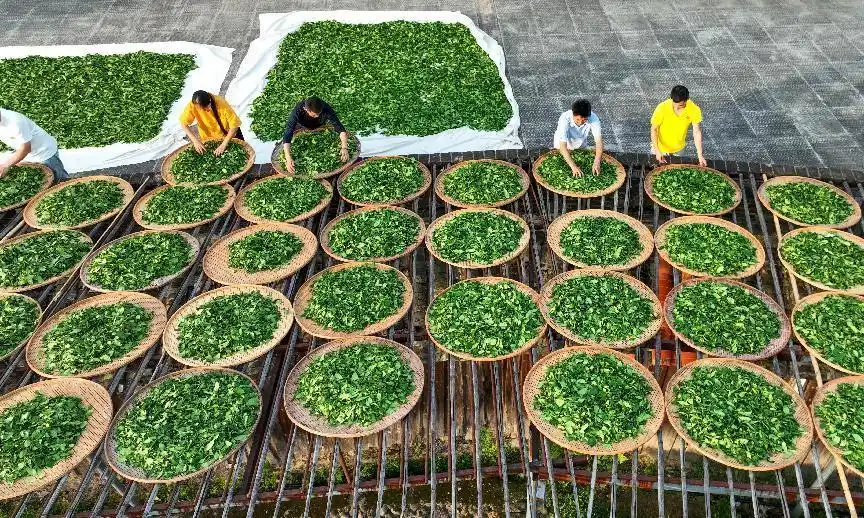
You cannot make Wuyi rock tea by following a fixed recipe. You have to listen to the leaves. Mount Wuyi, located in northwestern Fujian Province, is a UNESCO World Cultural and Natural Heritage site and the birthplace of rock tea. The production of rock tea can be traced back to the Han dynasty, and by the early Qing dynasty, a complete and sophisticated technique had been developed, pioneering the making of oolong tea. The famous “rock bone and flower fragrance” — a mineral, honey-like depth — comes from two things: the unique terroir of Mount Wuyi and an extraordinarily sensitive handcrafted process. The traditional ten steps include withering, shaking the leaves to control oxidation, pan-firing, rolling, and low-temperature baking. The most critical step is “watching the leaves to manage the oxidation” — the master decides, based on humidity, temperature, and the leaf’s own response, when to stop oxidation. No machine can replicate this judgment. Mount Wuyi is also the birthplace of both black tea and oolong tea. Ancient tea customs that grew up alongside rock tea production — such as “shouting at the mountain” to wake the tea spirits and competitive tea tastings — are still practiced today. For handicraft lovers, the beauty of rock tea production lies in this: it is not a fixed set of steps but an ongoing dialogue between human and nature. The tea master uses hand, eye, ear, and nose to sense every change in the leaves, responding with craft to the spirit of the mountain.