Heritage Grid | The Lost Capital of Kublai Khan’s Heir: Unearthing the Secrets of Yuan‘s FOURTH capital
The sudden disappearance of an imperial capital, lost to memory for over six centuries, only to be resurrected from the grasslands by the persistence of a local teacher and the trowels of archaeologists.
The ruins of Yuan Zhongdu, a brief imperial dream built on the northern grasslands
The Yuan Zhongdu site is located in Zhangbei County, Hebei Province, and represents one of the most well-preserved Yuan Dynasty capital city ruins.
The Yuan Dynasty (1271-1368), whose dominator was the Mongols, established a unique multi-capital system to govern its vast empire, which spanned the Eurasian continent. While the winter capital, Dadu (modern Beijing), and the summer retreat, Shangdu (now located in Zhangjiakou, Hebei province) are relatively well-known, a third capital had vanished into historical obscurity for over 600 years.
This was Yuan Zhongdu, literally the Middle Capital, a grand project that rose with dramatic speed, witnessed pivotal moments of imperial power, and fell into ruin almost as quickly. Its rediscovery in the late 20th century has provided an unparalleled archaeological snapshot of Yuan-era urban planning and the fusion of nomadic and Han Chinese cultures.
From White City to Imperial Capital: The Rediscovery
For centuries, the ruins near present-day Zhangbei County in Hebei Province were known locally as Bai Chengzi (White City). Historical memory had faded so completely that the site was long mistaken for a Liao Dynasty (907–1125) marketplace called Bei Yangcheng or a family fortress. This misidentification was so entrenched that in 1981, a county-level cultural protection stele was erected, labelling it as the Bei Yangcheng Site.
The breakthrough came from an unlikely source. In the same year, a local high school teacher named Yin Zixian(尹自先), driven by personal interest, conducted his own investigation of the site. Based on his findings, he boldly challenged the conventional wisdom, publishing an article in 1982 proposing that Bai Chengzi was actually the lost Yuan Zhongdu.
His hypothesis sparked scholarly debate, culminating in a 1997 academic conference that preliminarily confirmed his theory. Systematic archaeology began in 1998. What the archaeologists uncovered was astonishing: a meticulously planned city with the triple-walled concentric layout (palace city, imperial city, outer city) characteristic of major Yuan capitals like Dadu.
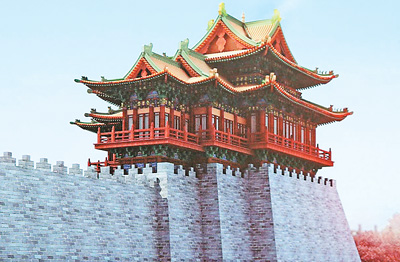
▲the restored image of the triple-eaved watchtower
The palace city's southwest corner tower provided a definitive clue. Its excavation revealed a triple-eaved watchtower (三出阙), an architectural form reserved exclusively for the Son of Heaven. The discovery of this highest-grade structure, along with artefacts like dragon-decorated glazed tiles and white marble chi-head spouts, left no doubt: this was an imperial capital. The discovery was hailed as a major breakthrough in Yuan archaeology and was selected as one of China's Top Ten Archaeological Discoveries of 1999.
A Meteoric Rise and Fall: The Brief History of Zhongdu
The story of Yuan Zhongdu is inextricably linked to one emperor: Yuan Wuzong (Emperor Haishan, the grandson of Kublai Khan). In 1307, at the age of 27, Haishan seized the throne after a succession crisis. Just twelve days after his coronation, he issued an edict: "Build a travelling palace at the place Wanguchadu (the location of Zhongdu) and establish palaces to make it the Central Capital".

▲The portrait of Haishan
His motivations were multifaceted:
Firstly, the strategic location: The site in present-day Zhangbei was a crucial strategic node on the postal route between Dadu and Shangdu, acting as a bulwark protecting Dadu from the north. It was also in the Dragon Rising region where his ancestor Genghis Khan had won decisive victories.
Secondly, the political Statement: As a prince who had spent years commanding armies on the northern frontiers, building a new capital was a powerful act of asserting his own authority and legacy, distinct from the established power centers of his predecessors.
Construction was frenetic. Wuzong mobilized over 21,500 soldiers as laborers to speed the work. Remarkably, the core palace structures were declared complete in just 13 months by 1308. However, work on outer walls and decorative elements like the contentious corner towers continued.
The emperor's ambitious dream was short-lived. He died in 1311, and his successor, Emperor Renzong, immediately halted all construction, citing the excessive burden on the people and treasury. Thus, Zhongdu's official status as a capital lasted a mere three years.
However, its story did not end there. Due to its prime location, it continued to serve as a major travelling palace for subsequent emperors on their seasonal journeys between Dadu and Shangdu. They used it for hunting, Buddhist ceremonies, and political gatherings. It was at Zhongdu in 1329 that an infamous fratricidal power struggle unfolded, resulting in the poisoning of Emperor Mingzong by his brother, who then retook the throne.
The final blow came with the Red Turban peasant rebellions that rocked the dynasty's final years. In 1358, rebel forces burned the palaces of Zhongdu to the ground, reducing the grand capital to the ruins that would slumber for centuries.
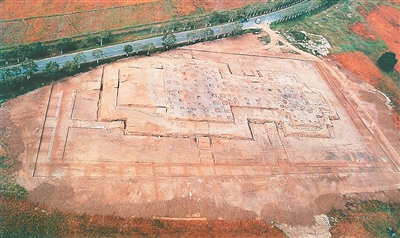
▲The bird's-eye view of Zhongdu ruins
Architecturally, Zhongdu was a clear successor to Dadu. Its "工"-shaped Main Hall (the only excavated example of a Yuan palace's core hall) and its triple-eaved corner towers were direct imitations of Dadu's grandeur. However, scholars note that it was even more geometrically perfect, as the main hall was placed at the exact center of the palace city, adhering more strictly to ancient Chinese canonical texts, such as the Rites of Zhou(《周礼·考工记》), than even Dadu did.
An Unparalleled Cultural and Archaeological Treasure
The very brevity of Zhongdu's active life is what makes it an archaeological treasure. Unlike Dadu (beneath modern Beijing) or Shangdu (which has extensive above-ground remains but also a long, complex history), Zhongdu offers a "frozen moment" from the early 14th century.
A Pure Example of Yuan Imperial Architecture: With minimal later construction over it, the site provides the clearest available blueprint of a Yuan Dynasty capital's layout, structure, and construction techniques.
A Fossil of Cultural Fusion: The city embodies the dual identity of the Yuan rulers. Its rigid, symmetrical Chinese layout and palatial halls coexisted with open spaces within the palace walls, believed to have been used for setting up traditional Mongolian ger (yurt) encampments, blending sedentary and nomadic lifestyles.
Evidence of Global Exchange: Excavations have yielded objects such as a magic square carved with early Arabic numerals on stone, as well as fine porcelain from kilns in Jingdezhen, Longquan, and Cizhou. These findings vividly illustrate Zhongdu's connection to the vast trade and cultural networks of the Mongol Empire.
A Window into Political History: The site is a physical archive of its dramatic history—from the unworn stone slabs of the central gate (indicating little use before abandonment) to the vitrified bricks and tiles that bear witness to the Red Turban rebellion's destructive fire.
Today, the Yuan Zhongdu National Archaeological Site Park, established in 2018, protects this legacy.
From a mislabeled patch of grassland to a recognized keystone of imperial history, the story of Yuan Zhongdu is a powerful reminder of how empires are built, how they dream, and how fragments of stone and earth can patiently wait to tell their stories to a future age.