Heritage Grid | Of Dragons, Astronomy, and the Dawn of China: The Lost Capital at Taosi
In the gentle folds of the Loess Plateau in China’s Shanxi province, near the sleepy village of Taosi, the earth holds a secret. For centuries, locals plowed fields and built homes, unaware that beneath their feet lay the remnants of a city so revolutionary, it would force the world to reconsider the very cradle of Chinese civilization.
This is not the story of a mythical emperor, handed down through poetic verse. This is a story written in soil, unearthed piece by piece by the trowels of archaeologists. It is the story of Taosi, a sprawling, walled metropolis that flourished between 2300 and 1900 BCE, a site that whispers tantalizingly of a sophisticated, powerful, and startlingly early state—one that some scholars daringly argue could be the legendary Ping capital of Emperor Yao.
A Metropolis Emerges from the Dust
Discovered in the 1950s and systematically excavated since the 1970s by institutes including the Chinese Academy of Social Sciences, Taosi is no ordinary Neolithic village. At its zenith, it encompassed a staggering 280 hectares, protected by a massive rammed-earth wall—a testament to an elite’s ability to mobilize labor on a prodigious scale. Walking its streets over 4,000 years ago, one would have sensed the buzz of a highly stratified society.
The city was meticulously zoned. A vast necropolis, holding over ten thousand graves, tells a silent but stark tale of inequality. The majority are small, shallow pits, their occupants buried with little more than their bones. But a select few are monstrous tombs, veritable underground chambers. Here, the elite were laid to rest on lacquered wooden biers, surrounded by a breathtaking array of prestige goods: entire pig skeletons, exquisitely painted dragon-motif pottery, jade cong (ritual cylinders), and zhang (blades) that signified connection to the heavens, and a collection of over a hundred musical instruments, including exquisite chime stones and clay drums. This wasn't just wealth; it was a statement of cosmological power and social distance.
The Emperor’s Observatory
Perhaps the most jaw-dropping discovery came from a peculiar structure on the southeastern edge of the city. Initially appearing as a fragmented semi-circle of rammed earth, meticulous excavation led by archaeologist He Nu revealed its true function. It was an astronomical observatory, the oldest of its kind ever found in China.
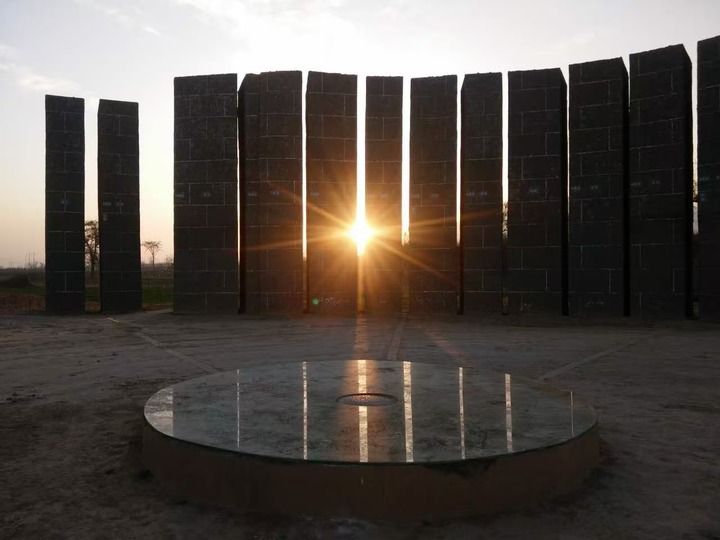
Thirteen towering pillars of rammed earth formed a precise arc. From a central observation platform, ancient astronomers—likely priest-kings—could mark the passing seasons by watching the sun rise through the narrow slots between the pillars. The precise solstices and equinoxes were charted, dictating the agricultural and ritual calendar that was the lifeblood of an agrarian state. This wasn't merely counting days; it was the act of mediating between heaven and earth, a divine right that legitimized the ruler’s absolute authority. The precision of this facility indicates a "highly developed astronomical knowledge system" crucial for governing a complex society.
A Violent End and a Lasting Legacy
The glory of Taosi was not eternal. Archaeological layers tell a story of a sudden, violent collapse. The magnificent walls were ruthlessly razed, the observatory desecrated and filled with rubble, and the elite tombs were smashed. In their place, smaller, cruder tombs appeared, containing victims of brutal violence. The evidence points not to an outside invasion, but to a visceral internal uprising—a revolution that tore the city apart from within.
This dark chapter is perhaps the most human element of the Taosi story. It speaks of a social contract broken, of an elite whose cosmic claims were no longer enough to hold a fractured society together.
Taosi forces a dramatic rethinking of the Three Dynasties (Xia, Shang, Zhou) narrative of China's origins. It proves that a complex, state-level society, with all its hallmarks—urbanism, social stratification, ritual sophistication, and scientific achievement—existed centuries before the Shang Dynasty at Anyang. It provides a powerful, archaeological prelude to the age of legends.
Was it Yao’s capital? The dating is compellingly coincident with the traditional dates of his reign. The observatory aligns perfectly with descriptions of his mandate to "calendar the seasons." While absolute proof may forever elude us, Taosi offers something perhaps more valuable: a tangible, awe-inspiring glimpse into the world that inspired the legends. It is the profound, complicated reality behind the myth, a place where the dragon was first painted on pottery and the sun was first pinned to the horizon by human calculation. It is, quite simply, where China began.
Related articles
-
 Heritage Grid | Dingcun: The Extraordinary Village Where Two Epochs of Human History Collide
More
-
The Timeless Legacy of Fenjiu: A Pillar of Chinese Baijiu Culture
More
-
Ancient Architecture: Best Place for Ground Cultural Relics
More
-
Heritage Grid | The Sacred Peaks: How these Five Mountains Forged Chinese's Identity
More
-
The Shanxi Merchants: A Commercial and Financial Legend of China
More