
Heritage Grid | China's "Fifth Great Invention"? The Imprint of a Civilization Shaped by Examinations
At the former site of the Nanjing Tributary Hall, those tiny examination cells—standing only six feet high, four feet deep, and three feet wide—were once where countless scholars saw their dreams either set sail or shattered.
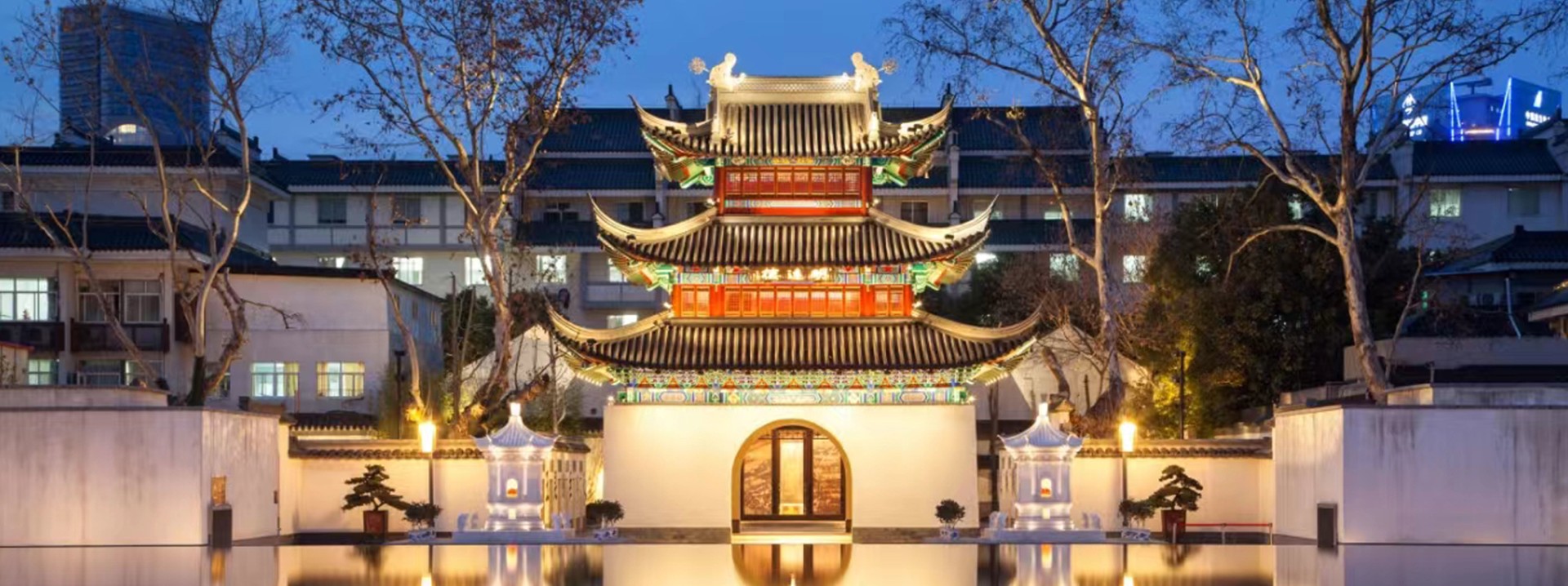
In ancient China, the Tributary Hall (Gongyuan), as the designated examination venue for the imperial examinations, was not only a place for selecting talent but also a vital symbol of traditional Chinese culture.
Tributary Hall Remains: Historical Witness to the Imperial Examination System
Tributary Hall architecture carries the memory of China's ancient imperial examination system. In the Yunnan Tributary Hall, an octagonal pavilion was built. Initially constructed to educate those who passed the examinations to uphold high moral standards after becoming officials, it was named the Pavilion of Moral Integrity (Fengjie Ting).
Its purpose was to instill in scholars the values of being upright and honest as officials, maintaining personal integrity, remaining loyal to the country, and having clear distinctions between love and hate.
At the Dragon Gate (Longmen), a mandatory passage point in the Tributary Hall, a pair of Xiezhì (mythical creature symbolizing justice) carved from red sandstone was placed. Legend has it that the Xiezhì could distinguish between right and wrong, was inherently loyal and upright, and would often gore the unjust with its horn. Its placement was intended to detect deceit and examine candidates attempting to cheat, serving as a deterrent.
The architectural layout of ancient Tributary Halls was highly distinctive. Provincial-level examinations (Xiangshi) in the Qing Dynasty were held in provincial capitals, where Tributary Halls were built. The outer walls of the Tributary Hall were fifteen feet high, covered thoroughly with thorns; hence, people called it the "Thorn Enclosure" (Jiwei).
Watchtowers were built at the four corners to monitor the entire complex. Inside, examination cells were built, arranged in rows like small alleys.
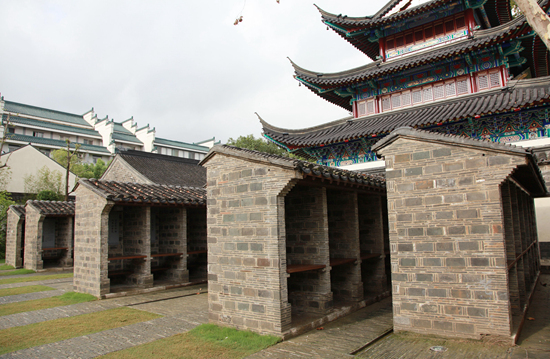
Today, these remnants of Tributary Halls are scattered across the country, bearing witness to the rise and fall of the imperial examination system. A former Tributary Hall site is preserved in Nanjing for tourists. In contrast, the ancient building Guancheng Hall, a surviving structure of the Gansu Tributary Hall, has fallen into disrepair and dilapidation due to age.
Examination Culture: The Evolution and Impact of a Thousand-Year-Old Testing System
The imperial examination system began during the Daye era of the Sui Dynasty, when Emperor Yang established the Jinshi degree, regarded as the start of the system. This institution lasted for approximately thirteen hundred years in Chinese history, until its abolition in the thirty-first year of the Guangxu era (1905) of the Qing Dynasty.
The imperial examinations were divided into different levels.
During the Tang and Song dynasties, the imperial examination system gradually matured. In the Tang Dynasty, examinations were categorized mainly into Regular Examinations (Gongju), Special Decree Examinations (Zhiju), Military Examinations (Wuju), and Child Prodigy Examinations (Tongziju). The Song Dynasty established the three-level examination held every three years, including the Local Examination (Jieshi), the Departmental Examination (Shengshi), and the Palace Examination (Dianshi).
In the Ming and Qing dynasties, the exams consisted of four levels: the Tongsheng Examination (also known as Tongshi or Yuanshi), the Provincial Examination (Xiangshi), the Metropolitan Examination (Huishi), and the Palace Examination (Dianshi). The content was essentially based on Confucian classics, using passages from the "Four Books" as topics, and the essay format was stipulated to be the "Eight-Legged Essay" (bagu wen).
Post-examination celebrations were colorful and varied. In the Tang Dynasty, after successfully passing the Jinshi examination, graduates were required to attend various ceremonies and activities, including paying respects to the Grand Councilor, thanking the chief examiner, and participating in gatherings with the same year's graduates.
After the personnel evaluation at the Ministry of Personnel, the new Jinshi graduates would also pool money to host a banquet at the Qujiang Pavilion in the southeast of Chang'an city.
Tales from the Examination Halls: The Contest Between Cheating and Anti-Cheating
In the imperial examination halls, the battle between cheating and anti-cheating never ceased. Candidates employed all sorts of tricks: some bribed officials to hide notes inside the examination cells or passageways; others, after entering the venue, had someone throw the exam questions out, hidden in bricks or stones.
People outside would compose essays on their behalf. Once finished, signals were arranged—like raising a lantern on a bamboo pole, setting off firecrackers consecutively, or releasing trained carrier pigeons with bells—to indicate the prearranged location for smuggling the answers back into the venue.
More ingenious methods were recorded. According to Miscellaneous Records of Jinglin, in the Ming Dynasty, some "recruited skilled writers to pen characters as small as fly heads on gold foil paper, with a thousand essays being less than an inch thick; some hid them in brush holders, or under inkstones, and even inside hollowed-out water droppers, double-layered straw sandals, and the like."
Even more astonishing, "others used medicinal juice to write on blue clothes or cloth trousers, which appeared to be plain; when dusted off, the characters would immediately appear, named: 'Essential Items for the Examination Hall'."
To prevent cheating, the court implemented strict measures. During the Ming and Qing eras, candidates underwent rigorous searches upon entry. Ai Nanying of the Ming Dynasty wrote an account describing the scene: "On the day of the exam, after the third drumbeat from the government office, even if covered in ice and frost, the scholars stood exposed outside the gate."
"They disrobed and stood naked, holding writing brushes and inkstones in their left hands, and cloth socks in their right hands, listening to the officials of the prefecture and county call their names, standing in order along the corridor, all the way to the front of the Supervisor's platform."
By the Qing Dynasty, the searches became even stricter. Candidates not only had to be searched physically (later changed to bathing and changing clothes), but their garments also had to have their seams unraveled; fur coats could not have linings, and carrying wooden cabinets, boxes, or double-layered stools was prohibited.
It was also stipulated that soldiers who detected one person smuggling illicit items would be rewarded with one tael of silver.
Inside and Outside the Tributary Hall: The Social Impact and Stories of the Examinations
The imperial examination system had a profound impact on society. It connected studying with holding office through examinations, institutionalizing the Confucian ideal of "those who excel in learning should become officials."
The examinations advocated fair competition, using test scores as the sole criterion for selection. The system became increasingly perfected, praised by Ouyang Xiu of the Northern Song Dynasty as the "system of ultimate impartiality."
Over thousands of years, the imperial examinations not only selected officials for the court but also shaped the intellectual spirit.
Some participated in the Metropolitan Examination, achieved the Jinshi degree, and became virtuous and capable individuals of high moral standing. During the Qianlong era of the Qing Dynasty, the outspoken censor Qian Feng, praised by contemporaries as having "a pure wind and bright integrity, shining throughout the land," became a representative figure of uprightness and integrity.
Echoes from Past to Present: The Contemporary Value of Examination Culture
The imperial examination system is hailed as China's "Fifth Great Invention." Although today the imperial examination system has been abolished for over a century, its spirit still resonates in modern society.
The rational core of the examinations—open tests, fair competition, selection based on merit—remains applicable to contemporary society.
Whether in China or other countries worldwide, people infinitely desire the spirit of fairness and justice and tirelessly pursue a model of governance achieved through fair competition.
Related articles
-
 Cafe in Yunnan: Good Environment Leads to High Quality
More
-
Yunnan's Frontier Culture: a Tapestry of Tradition, Resilience and Global Connection
More
-
The Tea-horse Road: a Historic Trade Route Connecting Cultures and Economies in Asia
More
-
Yunnan, Kingdom of Fungi
More
-
The Ancient Dian Culture: Unique Ethnic Historical Culture
More