Heritage Grid | Kucha's Gateway Art - The First Fusion on Buddhism's Path to China
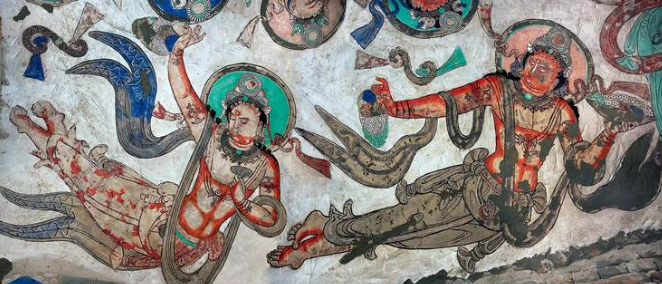
▲This is a rare giant flying aspara on the ceiling of Cave 80 of Kizil Caves.
The flying aspara here is a bearded, strong-bodied male figure, which is the earliest image of Bodhisattva in Indian Buddhism.
Imagine a caravan emerging from the Taklamakan Desert’s shimmering haze, camel bells clanking wearily. Before them rise not barren dunes, but a vibrant oasis cradled by the Tian Shan mountains – the ancient state of Kucha (Kuqa). For over a millennium, this crossroads pulsed with life, its legacy whispering secrets more profound than mere ruins.
Modern Kuqa County in Xinjiang, China, cradles the physical remnants of this powerhouse. Strategically positioned along the Northern Silk Road route, between the formidable Taklamakan Desert and the soaring Tian Shan range, Kucha wasn't just a stopover; it was a crucial pivot point. From roughly the 2nd century BC to the 14th century AD, it thrived as one of the 36 states in the western regions and later a key regional center. Its lifeblood was the flow of goods, ideas, and faiths between China, India, Persia, and the Mediterranean.
Kucha’s true treasure lies not in crumbling walls, but in its profound cultural synthesis, most magnificently preserved in its Buddhist cave temples:
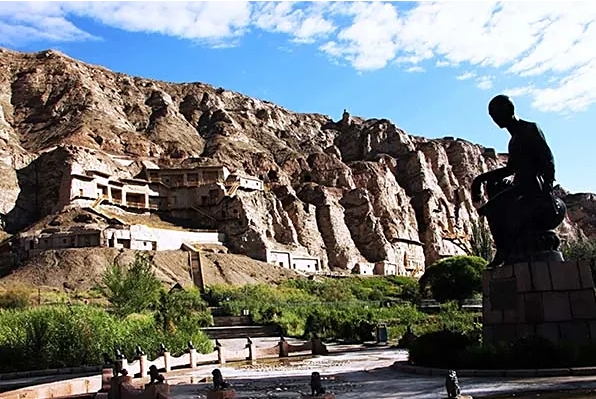
▲ The statue of Kumarajiva, together with the saluette of Kizil Caves
Kizil Caves (克孜尔千佛洞) are often called the "Cradle of Buddhist Art in China," and these caves predate the more famous Mogao Caves at Dunhuang by centuries.
Their murals showcase a breathtaking fusion of Indian, Persian, Hellenistic, and indigenous Central Asian styles. Unique "Kucha style" figures, draped in elegant robes with distinct facial features, dance across the walls alongside intricate geometric patterns.
The Kizil Caves are the earliest witnesses of the eastward spread of Buddhist caves.
Yet the most devastating chapter unfolded with the systematic plunder of Kizil’s murals. From the late 19th to early 20th century, foreign expeditions conducted large-scale extraction operations across the Kucha cave complexes, with Kizil suffering catastrophic losses. Researchers analyzing wall scars estimate nearly 500 square meters of murals were looted by these so-called archaeological teams – leaving skeletal grottoes as silent testimony to cultural violence.
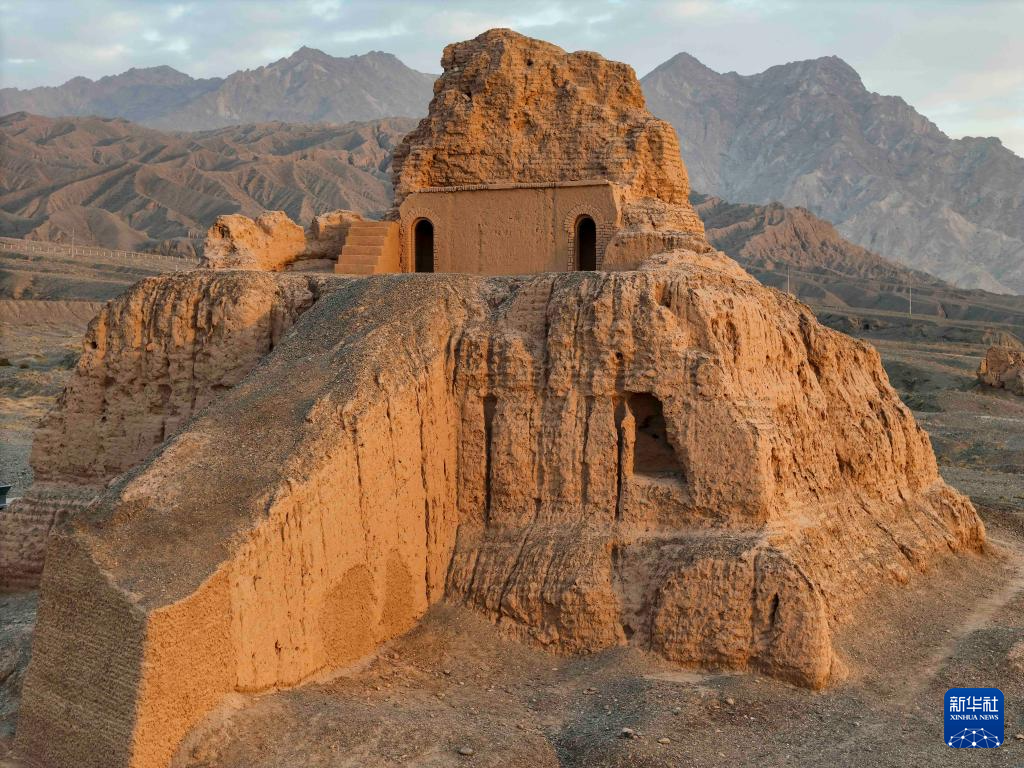
▲ The remains of the Subashi Monastery
Subashi Monastery (苏巴什佛寺遗址): The sprawling ruins near modern Kuqa town evoke the sheer scale of Kucha’s Buddhist devotion. Stupas, temples, and monastic quarters stretch across the landscape, silent witnesses to the kingdom’s role as a major center of Buddhist learning and translation.
It was here that the influential monk Kumārajīva (鸠摩罗什, 344–413 CE) began his journey before being taken to Chang'an (modern Xi'an), where his translations of Buddhist sutras into Chinese profoundly shaped East Asian Buddhism.
Within China’s rich heritage landscape, Kucha holds a distinct position:
Versus Dunhuang (Mogao Caves): While both are Silk Road Buddhist art giants, Kizil is significantly older. Its art exhibits stronger, more direct influences from Gandhara (Greco-Buddhist art of ancient Pakistan/Afghanistan) and Sassanian Persia, reflecting its position as an earlier conduit for Buddhism into China. Dunhuang, further east, shows a later, more Sinicized evolution.
National Cultural Heritage Administration of China recognizes this distinctiveness, listing Kizil on China’s Tentative List for UNESCO World Heritage nomination, specifically highlighting its "early Buddhist cave art" and "unique position in cultural exchange."
Globally, Kucha finds parallels in other Silk Road hubs like Samarkand (Uzbekistan) or Bamiyan (Afghanistan, tragically damaged), sharing the narrative of cultural exchange. Its specific focus on early Buddhist cave art resonates with sites like India’s Ajanta Caves, though Ajanta’s narrative art differs significantly.
The winds whistling through Subashi’s ruins bring it fragility. Time, climate, past neglect, and the sheer complexity of preservation pose immense challenges. Conservation efforts by Chinese and international teams are ongoing, a race against entropy to stabilize fragile murals and structures.
Visiting Kucha today is a pilgrimage to the source. Standing before the Kizil murals – the faded lapis lazuli blue still glowing, the graceful lines of a celestial musician – one doesn't just see art; one feels the vibrant pulse of a world connected.
Kucha wasn't merely a dot on the Silk Road map. It was a crucible where Asia’s diverse soul was forged.