Ancient Civilizations Find Common Ground
Teaming up, archaeologists try to answer historical mysteries and boost understanding of each other's past, unveiling parallels in their origins and philosophies, Wang Ru reports.
The construction methods of the enormous Egyptian pyramids have long remained a puzzle. Some have even argued that they could not have been constructed solely by the ancient Egyptians, suggesting the involvement of extraterrestrial beings. However, archaeological studies offer a key to solving some of the pyramids' mysteries.
In 2013, at the ancient port site of Wadi al-Jarf near the Red Sea, French archaeologist Pierre Tallet and his team discovered scrolls of well-preserved papyrus in a cave, which turned out to be a daily work log by a man called Merer who, more than 4,500 years ago, led his team across Egypt and beyond the Red Sea to gather materials for building the pyramids.
Merer meticulously recorded how he and his colleagues traveled by boat to transport the giant stone materials to Giza, with details of their travel duration, the number of stones they transported, and the names of canal checkpoints along the way, unveiling that the construction of the pyramids was a national project supported by precise calculations, efficient logistics, and a highly organized bureaucratic system.
The importance of archaeological studies in decoding the past was highlighted by Gao Wei, a Chinese researcher at the Chinese Academy of Social Sciences' Institute of Archaeology, during the recent salon Embracing Cultures, hosted by China Daily, which examined how digging up the past offered inspiration for modern people.
Gao joined the discussion with Alexander J. D. Westra of Greece, from the Key Research Institute of Yellow River Civilization and Sustainable Development at Henan University, and two moderators from China Daily.
The two archaeologists explain that archaeology is richer than people usually imagine.
"Some people think archaeology is about digging and discovery. It is not wrong, but that is only part of it," says Gao. "Archaeology is a science focusing on ancient materials. It uses many scientific methods such as geographical, biological and physical analysis. Apart from digging, archaeologists gain a lot of knowledge that they must analyze in the laboratory."
Through hard work in the field and in laboratories, Chinese archaeologists have significantly labeled human history by proving China's million-plus years of humanity, 10,000 years of culture, and more than 5,000 years of civilization.
"Things we now assume were always the case, such as China's very long history, come from archaeological discoveries," says Westra. "A community of scholars have worked for decades to generate this knowledge, which is now common sense. Scholars have made impressive archaeological contributions to science."
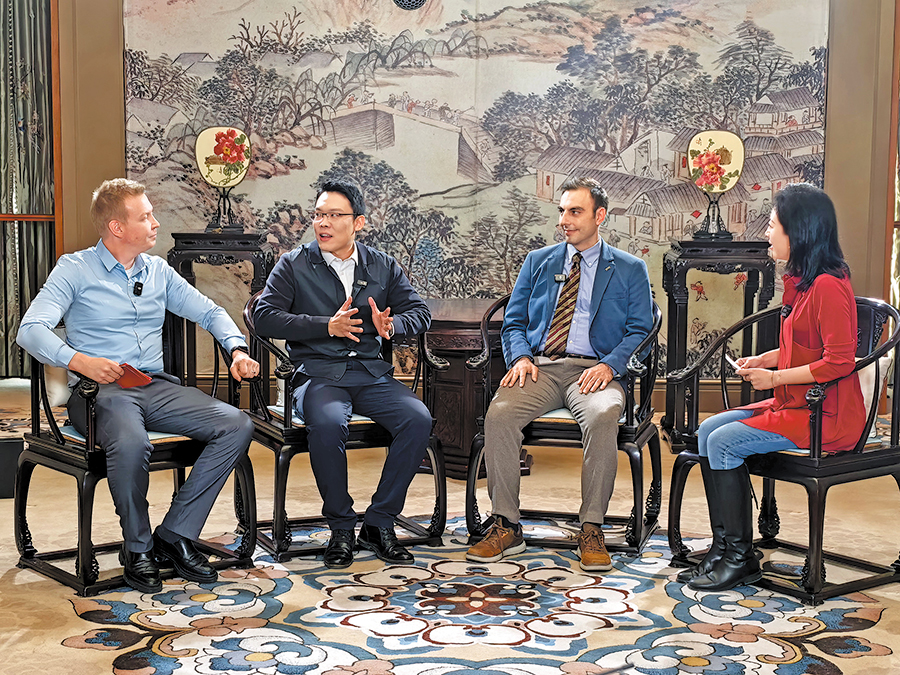
▲Gao Wei (second left), a researcher at the Chinese Academy of Social Sciences and Alexander J. D. Westra (second right) from Henan University, with two moderators from China Daily in a salon in Beijing last month.[Photo by Wang Kaihao/China Daily]
Shared value
Westra chose Henan province for his studies on environmental archaeology and comparisons in archaeological cultures, because he felt China's history wasn't prominent enough in world history records, with many mysteries waiting to be solved. Henan, as "the cultural heartland of China" and one of the birthplaces for the world-famous Yellow River civilization, is an ideal location for gaining such knowledge.
"The more I read chapters of human history, mostly written by Western historians, I found that the China chapter was a bit too short for what it should be. Therefore, I wanted to come here and discover what should be added. There is a vast amount of knowledge here that is gradually seeping into world history, but there's much more to add," he says.
"As my academic interest drew me to study China in great detail, the less I wanted to study it from a distance. I wanted to be there …where you have clusters of archaeological sites and can get a sense of the landscape, the light and the soil. Seeing it for yourself is the most fundamental experience for an archaeologist," he adds.
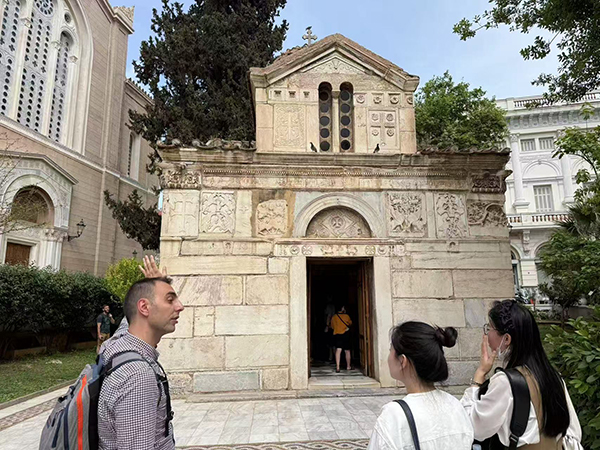
Westra played a role in establishing The Chinese School of Classical Studies at Athens, an institute founded in 2024 to promote academic research and exchanges on classical civilizations worldwide. From his perspective, China and Greece have a lot in common, which enables such cooperation.
"I think China and Greece are societies that have a deep desire to understand, write, and communicate about the world around them to essentially think their way out of problems and crises that they developed," says Westra.
Two great thinkers, Confucius and Plato, emerged in both countries around the same period — the 5th century BC — and developed similar ideas in cultivating oneself, education, and moral ethics.
"Plato and Confucius emerged in times of relative instability and thought about what morality is, what order is, what virtue is, and how to maintain order in the world around them," says Westra.
Westra believes that by reflecting on each other's history and experience, both countries can benefit from valuable lessons.
"Greek history will benefit a lot from the Chinese perspective of history. From my understanding, Chinese history tends to think in dynastic arcs or the long-term continuity of events, whereas Greek history is more punctuated by disconnected moments. I think there is a lot of value in looking at Greek history in a similar long arc of development as the Chinese do to their own past," says Westra.
He also believes Greek archaeologists can learn from their Chinese counterparts by combining archaeological fieldwork with textual evidence to generate a better understanding, as in the past they tended to separate them into distinct categories.
"When you study another civilization, you start looking at your own a little differently," he says. "We tend to work in our own little space, and then suddenly you discover other ideas or other perspectives of history, and that can shift a little bit, or at least enrich your perspective. So, it's a very novel and very innovative approach to history."
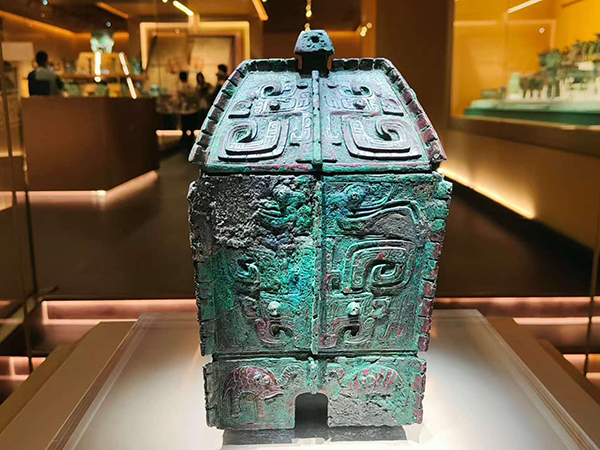
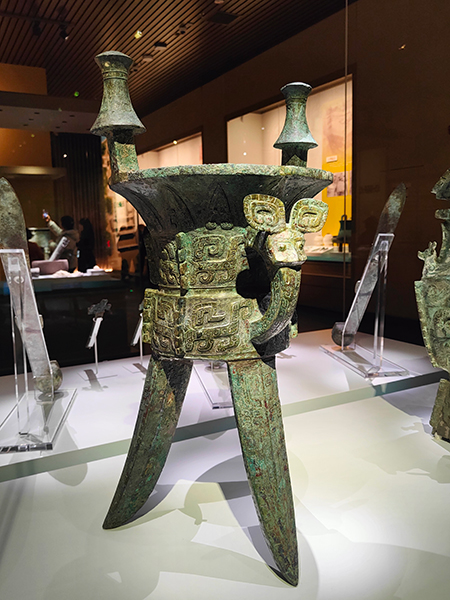
▲A bronze drinking vessel and a bronze wine container from the late Shang Dynasty (c. 16th century-11th century BC) Yinxu Ruins in Anyang, Henan province.[Photo by Wang Ru/China Daily]
Enhancing cooperation
From 2024 to 2025, the Shanghai Museum's On Top of the Pyramid: The Civilization of Ancient Egypt exhibition marked successful cooperation between the museum and the Egyptian antiquities authorities, attracting over 2.77 million visits in its 13-month run.
Gao highlights the display as "the cultural event of the year", owing its success to the curators' creative displays and activities that attracted large audiences every month, the charm of ancient Egyptian civilization, which remains mysterious and also offers archaeological evidence for discussion, and, more importantly, the Chinese people's interest in other civilizations.
"I feel strongly that Chinese people today want to get closer to other ancient civilizations. It becomes part of their cultural life," Gao says.
Chinese archaeologists have participated in unveiling more about Egypt's past. An official Chinese-Egyptian joint archaeological mission was launched in 2016 by the Institute of Archaeology at the Chinese Academy of Social Sciences and Egypt's Ministry of Tourism and Antiquities, focusing on studies of the Temple of Montu, part of the Karnak Temple in Luxor, an ancient city.
Gao is a member of the joint archaeological team. He says that in the past decade, the cooperation has achieved many successes by enriching understanding of the layout of the site, its construction process, functional changes over time, and its place in history.
"Ancient Egyptian civilizations were iconic in our minds, and my Egyptian colleagues had the same impression of Chinese civilizations. But after working together for almost 10 years, I have seen a branching out, which helps deepen each other's understanding of our cultures," says Gao.
Both Egypt and China have such long histories; their ancient cultures are often compared. For example, China's Shang Dynasty (c. 16th century-11th century BC) ruled during a similar time to Egypt's New Kingdom, which makes it possible for comparative studies between the civilizations.
Gao recalls the moments when the whole team truly connected. In March 2020, when the COVID-19 pandemic broke out, Chinese members had to stay in Luxor for several months. Their Egyptian colleagues offered food and protective masks and took care of them as if they were family members.
Moreover, on March 1, he saw the Egyptian government's support for China's fight against the pandemic by lighting up the first pylon of the Karnak Temple with China's national flag.
"It was really moving and unforgettable," he says.
Westra speaks highly of the joint project. "The mission is very symbolic of China's engagement with world heritage and willingness to preserve human heritage around the world," he says.
Speaking about ancient wisdom that inspires the modern world, Gao says that when ancient Egyptians built the pyramids, they used materials from around the world. He believes we still need to "find the wisdom to collaborate and create the future we want".
Westra highlights the long-term and the planting of something positive for future generations.
"An ancient Greek proverb says,'Wise people plant trees whose shadow they will never enjoy'. I think if there is something we learn from the past, it is that people lived their lives, they satisfied their needs and desires, and they built something for posterity.
"We build something today that we may never see the fruits of. This idea of leaving something positive for the future is one lesson I would keep from the past," Westra says.
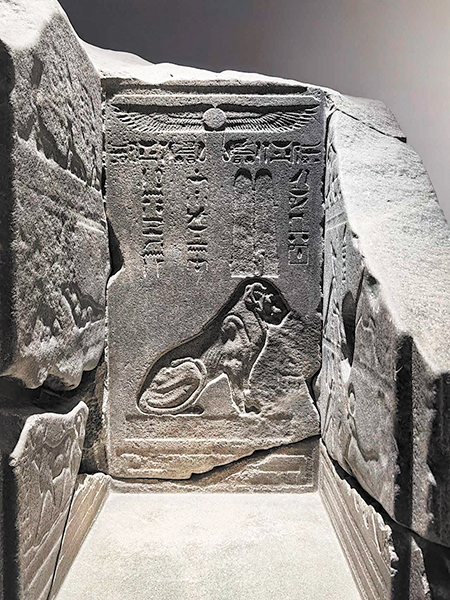
▲Part of a stone coffin on display at the Graeco-Roman Museum in Alexandria, Egypt, from the 4th century BC.[Photo by Gao Wei/For China Daily]
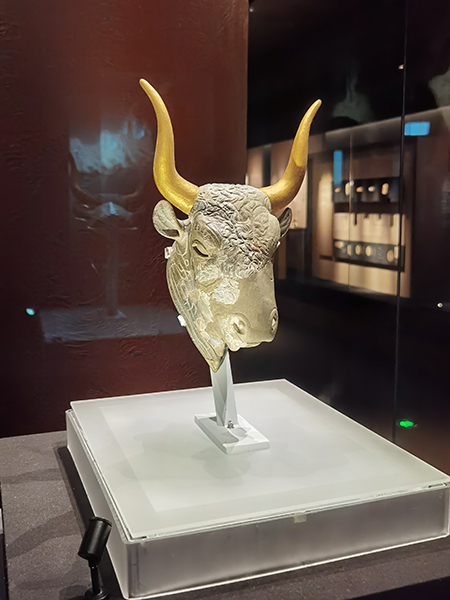
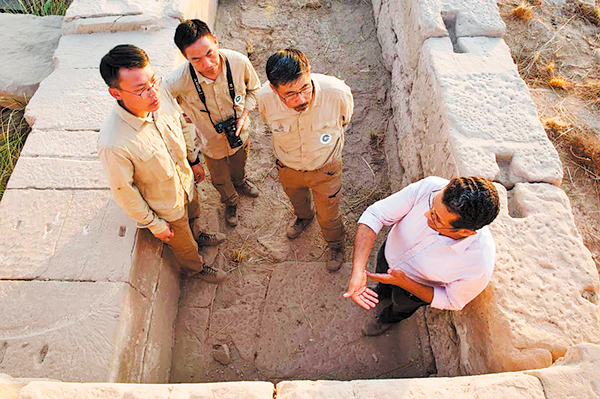
▲Gao (left) and other members of the Chinese-Egyptian joint archaeological team discuss the site they are working on in Egypt in 2018.[Photo provided to China Daily]