Si Shu Wu Jing - Four Books and Five Classics
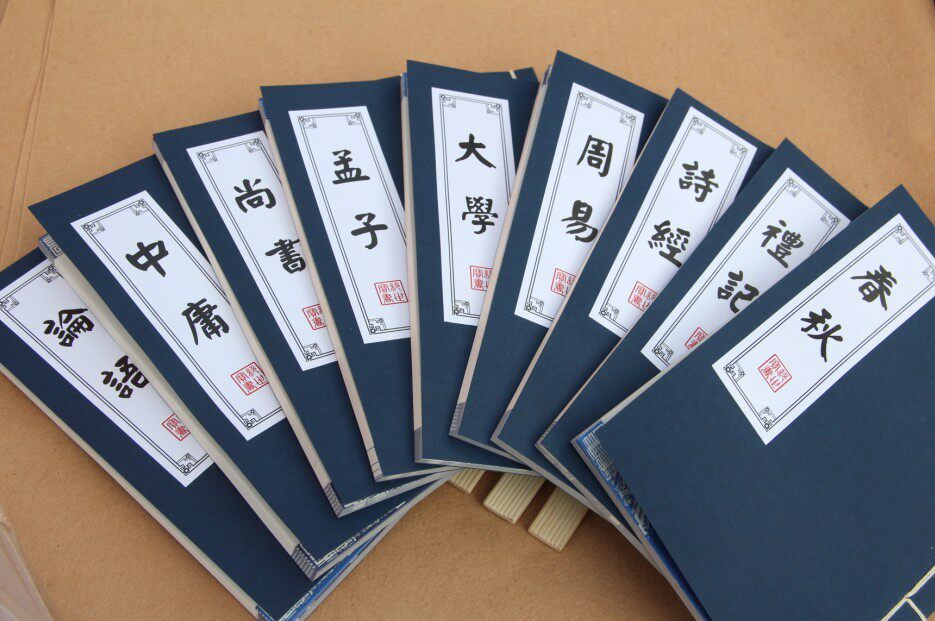
Four Books and Five Classics
Si Shu Wu Jing, or the Four Books and Five Classics, is a collective term for ancient Chinese Confucian classics. Comprising the “Books” series and the “Classics” series, these works contain detailed historical documents covering politics, military affairs, diplomacy and culture as well as ideas of thinkers like Confucius and Mencius, thereby serving as an important guide to Confucian philosophy.
The classics series originally consisted of the Six Classics passed down from ancient times. Confucius (c. 551-579 B.C.) and his disciples edited and compiled them. Later, one of the classics, Yue (Records of Music), was lost, so only five now remain.
They are: Shijing (Book of Songs), the first anthology of Chinese poetry; Shangshu (Classic of History), a collection of documentary records of events in China’s ancient history; Liji (Book of Rites), a record of social norms and rites in ancient times; Yijing (Book of Changes), an explanation of how the ancestors explored the universe and human world through divination; and Chunqiu (the Spring and Autumn Annals), a historical book that offers insightful political wisdom via the official chronicle of the State of Lu back in the Spring and Autumn Period (c. 770-476 B.C.).
During the Western Han Dynasty, Emperor Wudi (156?-87 B.C.) designated Confucianism as the official guiding principle, so the Five Classics became an important basis for the government to recruit talent, formulate policies, and educate the people.
The Four Books refer to the Analects, the Mencius, the Great Learning, and the Doctrine of the Mean. The Analects and the Mencius mainly record ideas attributed to Confucius and Mencius and stories about them. The Great Learning and the Doctrine of the Mean were originally two chapters from Liji (Book of Rites), until Zhu Xi (1130-1200), an ancient Chinese thinker of the Song Dynasty (960-1279), extracted them and compiled them into the Four Books together with the Analects and the Mencius. Zhu Xi also compiled annotations and comments for the Four Books based on some excellent works of others. He saw the Four Books as the basics of Confucianism and could serve as the step ladder to study the Five Classics.
The Four Books and the Five Classics were essential readings for the intellectual elite, and the ideas promoted therein constituted the philosophy of government throughout China’s ancient period, exerting a profound influence on the development of Chinese society and culture. As an essential component of traditional Chinese culture, this collection occupies an important place in world history and remains an important reference source for understanding traditional Chinese thought and culture.
This piece is compiled from the Keywords to Understand China by China International Communications Group, Academy of Contemporary China and World Studies and China Academy of Translation.