
Heritage Grid | Dingcun: The Extraordinary Village Where Two Epochs of Human History Collide
What if one village could tell the story of two entirely different human worlds—separated by 100,000 years?
In northern China’s Shanxi Province, along the banks of the Fen River, lies Dingcun—a place that holds a secret no other site on Earth can claim. Here, beneath the shadow of elegant Ming Dynasty courtyard walls, archaeologists made a discovery that would rewrite human history. And yet, most of the world has never heard its name.
A Village Built on the Bones of the Ancients
The story of Dingcun is actually two stories—one buried deep beneath the other.
In 1953, as workers dug for sand along the Fen River, they unearthed something unexpected: stone tools, animal bones, and eventually, three fossilized human teeth. The discovery stunned the archaeological world. These were not ordinary remains. They belonged to a previously unknown human population—what scientists would call Dingcun Man (Homo sapiens daliensis), an early form of Homo sapiens who lived approximately 120,000 to 100,000 years ago.
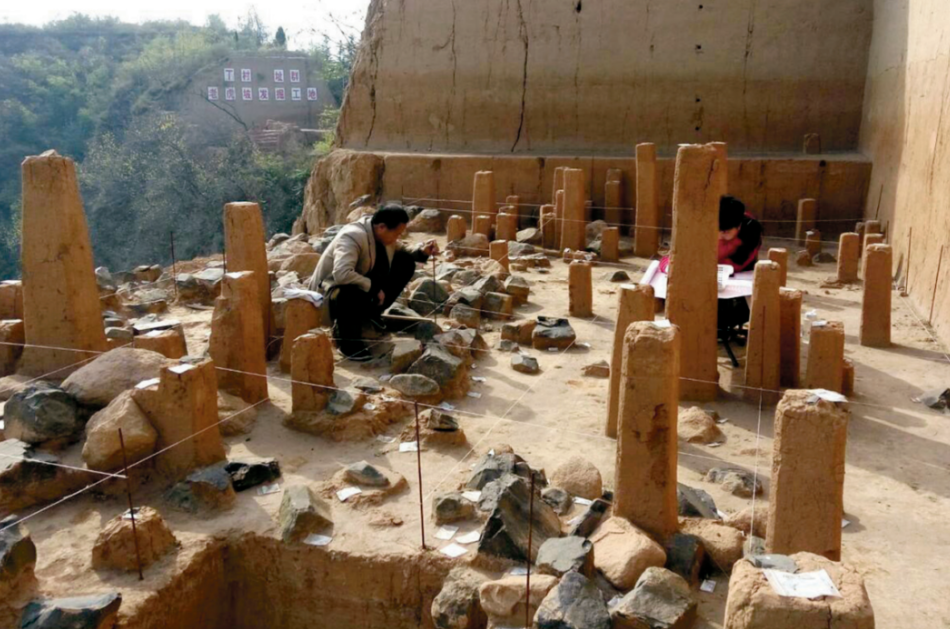
Over the next decades, excavations revealed over 2,000 stone artifacts, 28 species of mammal fossils, and human cranial remains spread across 13 localities spanning 11 kilometers along the riverbank. What emerged was a complete picture of a Middle Paleolithic hunting culture—people who crafted sophisticated tools, hunted in organized groups, and survived the harsh climate of the last interglacial period.
Then came the second story.
On the very ground where ancient hunters once roamed, a wealthy merchant village flourished. Between 1593 and the early Republic period, Dingcun’s residents built 40 complete courtyard compounds, covering 48,000 square meters—the largest and best-preserved collection of Ming and Qing dynasty vernacular architecture in northern China.
The Genius of Two Worlds
What makes Dingcun’s prehistoric heritage extraordinary is not just its age—it’s what the artifacts reveal.
Recent scholarship has challenged old assumptions. For decades, Western archaeologists believed East Asia’s Paleolithic technology was primitive compared to the Acheulian tool cultures of Africa and Europe. But Dingcun’s lithic assemblage tells a different story. Re-examined in 2014, researchers identified classic Acheulian tool types—handaxes, cleavers, and picks—dating to 160,000–210,000 years ago. The site stands as a direct challenge to the so-called Movius Line, demonstrating that sophisticated bifacial technology existed in East Asia far earlier than once thought.
As for the Ming-Qing village—here, architecture becomes a living museum of social aspiration. The 40 courtyard houses are arranged in four clusters: north, middle, south, and northwest, each representing distinct building periods. The Ming structures, with their bold painted eaves and simple wood carvings, sit alongside Qing buildings adorned with extraordinary woodwork depicting Confucian parables, folk entertainments, and scenes from Chinese opera.
Nowhere is the craftsmanship more evident than in the No. 1 courtyard, built in the 54th year of Emperor Qianlong. Its wooden panels carry intricate carvings of “Yue Fei’s Mother Tattooing,” children flying kites, and the legendary “Sima Guang Breaking the Vat”—scenes that blend moral instruction with everyday joy. The stone carvings are equally remarkable: plinths and door blocks adorned with symbols of longevity, prosperity, and domestic harmony—money peaches, five bats representing five blessings, and the playful “monkey holding money”.
Why Dingcun Matters to the World
Dingcun is not merely a Chinese treasure—it is a site of global significance, recognised on UNESCO’s Tentative World Heritage List since 1996 under criteria (ii), (iii), (iv), and (v).
Its importance lies in the extraordinary temporal convergence: a single location preserves evidence of two transformative eras in human history—the emergence of early modern humans and the flowering of Chinese mercantile culture. Few sites on Earth offer such a complete stratigraphic and architectural record.
Compared with contemporaneous sites, Dingcun’s Ming-Qing architecture stands apart. Unlike the fortified merchant compounds of Shanxi’s central basin (such as the Qiao or Wang family compounds), Dingcun’s houses emphasise domestic intimacy over commercial display. Halls were not for living but for ancestral worship, weddings, and storage—a unique local custom that distinguishes Dingcun from all other northern Chinese domestic architecture.
Meanwhile, the Palaeolithic component places Dingcun alongside Zhoukoudian as one of China’s foundational archaeological sites—the first major Palaeolithic excavation conducted entirely by Chinese researchers after 1949, and the first to fill the critical gap between Peking Man and modern humans.
A Legacy Suspended in Time
Today, visitors can walk the same flagstone lanes where Ming merchants once strolled and stand on earth where Ice Age hunters knapped their stone tools. The Dingcun Folk Museum preserves the courtyards in their original splendour. At the same time, ongoing excavations continue to uncover new secrets—most recently, in 2015, a 300,000-year-old fire-use site at nearby Guoshui Cave and a 170,000-year-old stone tool workshop at Jiulong Cave.
Dingcun is not a single story. It is a dialogue across millennia—between hunter and merchant, between ancient stone and carved wood, between a China of the distant past and the world we inhabit today. It asks us to consider: how much of what makes us human has been shaped in places exactly like this?
Related articles
-
 Heritage Grid | The Sacred Peaks: How these Five Mountains Forged Chinese's Identity
More
-
The Timeless Legacy of Fenjiu: A Pillar of Chinese Baijiu Culture
More
-
Ancient Architecture: Best Place for Ground Cultural Relics
More
-
The Shanxi Merchants: A Commercial and Financial Legend of China
More
-
Heritage Grid | Of Dragons, Astronomy, and the Dawn of China: The Lost Capital at Taosi
More