
Heritage Grid | Is This Modest Stone Shrine the World’s Oldest Surviving Filial Piety Monument?
Perched atop Xiaotang Mountain in Changqing District, Jinan, stands an unassuming stone structure that has witnessed nearly two thousand years of history. But here lies a puzzle: whose tomb does this shrine serve? The name — Guo Family’s Tomb Shrine — points to a legendary filial son named Guo Ju, whose story of burying his own child to save his mother from starvation became one of the Twenty-Four Filial Exemplars. Yet the earliest known record, found in the 6th-century Commentary on the Water Classic by Li Daoyuan, treats this identification merely as local hearsay. Could the true occupant be far more significant than legend suggests?
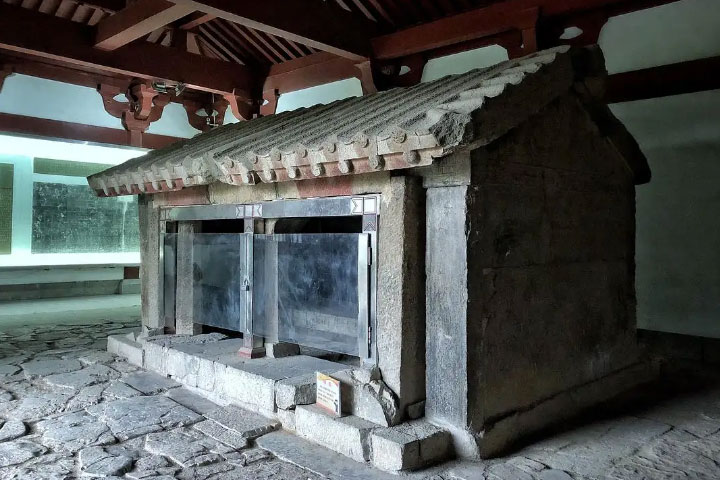
The Stone That Outlived Empires
Hidden by pine groves at the summit of Xiaotang Mountain, the shrine is the earliest surviving stone-built surface structure in China. Constructed around the late 1st century CE during the Eastern Han dynasty (possibly 76–105 CE), this small hall measures just 4.14 meters wide, 2.5 meters deep, and 2.64 meters high — roughly the size of a modern studio apartment. The entire structure is assembled from bluish-grey stone slabs, faithfully replicating in miniature a typical Han-dynasty residential building. The single-eaved, overhanging-gable roof is carved with meticulous imitation-timber details: roof ridges, tile rows, eaves brackets, and rafters are all rendered in stone.
Inside, an octagonal stone pillar divides the space into two chambers, while a triangular stone beam transfers the roof’s weight to the back wall — an ingenious load-bearing solution that has allowed the structure to stand for nearly two millennia.
A Picture Scroll Etched in Stone
The shrine’s true marvel lies not in its architecture alone but in the 36 sets of incised relief carvings that cover its interior walls and beams. These images form a comprehensive visual encyclopedia of Han-dynasty life. A grand King’s Procession scene stretches across the upper register of three walls, depicting an elaborate entourage of chariots and horsemen — indicating that the tomb’s occupant once participated in the retinue of a feudal king. Below, a 2,000-stone Official’s Procession identifies the deceased as a senior prefect-level administrator, likely a chancellor or tutor to a vassal king.
Historical narratives fill the remaining spaces: Confucius respectfully seeking instruction from Laozi — a powerful symbol of the era’s intellectual synthesis; the young Duke of Zhou. (whose manor is located in the Baoji city of Shaanxi today) acting as regent for the child King Cheng, representing ideal governance; even dramatic scenes of warfare between Han and northern nomads. Mythological figures also appear — Fu Xi and Nü Wa, the Wind God Feng Bo, and the Thunder God Lei Gong. Carved in an elegant incised-line style, these images are sparse yet vivid, forming one of the finest surviving examples of Han pictorial art. Above it all, carved across the underside of the triangular beam, a celestial map of sun, moon, and stars watches over the hall.
Why This Shrine Matters
In an era when Confucian ideals were becoming the organizing principle of imperial governance, the Eastern Han government institutionalized the xiaolian (Filial and Incorrupt) system, requiring officials to embody both familial devotion and personal integrity. In this context, the tomb shrine functioned as a perpetual moral lesson: a stone-cut textbook of Confucian virtue, reinforcing the social order through images of filial piety, ritual propriety, and exemplary leadership. By 570 CE, the regional governor Hu Changren carved Ode to Grateful Filial Piety on the shrine’s western wall, cementing its status as a monument to virtue and ensuring the local village would be renamed Filial Village — a name it still bears today.
In architectural history, the Xiaotang Mountain Shrine holds a singularly important position. It represents the sole fully intact example of a Han-dynasty stone ancestral hall, a type of structure that once proliferated across eastern China. While the celebrated Wu Family Shrines of Jiaxiang County have been reduced to scattered stone fragments, the Xiaotang Mountain Shrine stands complete. For understanding how ordinary Han-dynasty houses were built — their scale, their structural logic, their visual grammar — this modest stone shrine is an irreplaceable document.
The true identity of its occupant may never be known. But in a world that constantly destroys and forgets its past, the Xiaotang Mountain Guo Family Tomb Shrine delivers a quiet but powerful message: some things, if built well and with purpose, can speak across two thousand years.
Related articles
-
 Heritage Grid | The Sacred Trinity of Qufu: Confucius’ Temple, Forest, and Mansion
More
-
Qilu Culture: Prosperous cultural treasure
More
-
Heritage Grid | The Sacred Peaks: How these Five Mountains Forged Chinese's Identity
More
-
Heritage Grid | Mount Tai: Where Heaven Meets Earth
More
-
Heritage Grid | "United States of China”? Wait, the Term May Be Applicable in West Zhou Dynasty !
More
-
Mount Tai: The Symbol of Shandong
More