
Heritage Grid | The Twin Pillars of a Dynasty: The Dual Capital System of Han China (Luoyang)
The establishment of the Eastern Han dynasty in 25 AD turned the Han dual-capital system on its head. Emperor Guangwu's choice of Luoyang as the primary capital was a geopolitical and ideological masterstroke that redefined both cities. Chang'an, the majestic western fortress, was not abandoned but transformed into a potent symbolic anchor, a Western Capital (Xidu) laden with ancestral memory. This shift from a Western Han model of "Martial Chang'an, Civil Luoyang" to an Eastern Han reality of "Administrative Luoyang, Ceremonial Chang'an" reveals the system's adaptability and deep cultural logic.
Luoyang in the Eastern Han blossomed into a streamlined, ideological powerhouse. Rebuilt as the magnificent Nine-Six City (named for its approximate dimensions of nine by six li), it embodied a new imperial philosophy. Unlike Chang'an's adaptive, sprawling layout, Luoyang's plan was more regular and intentionally symbolic. Its North-South central axis, centered on the palace's main gate (Changgemen) and the grand processional way, became a physical manifestation of centrality and order. This design, emphasizing a single, powerful axial core, directly influenced the planning of later Chinese capitals for millennia. Luoyang's essence was intellectual and ritualistic. The Southern Suburbs housed the Piyong (Imperial Academy), the Lingtai (Spirit Terrace for astronomy), and the Mingtang (Bright Hall for rites), forming a colossal ritual-academic complex. The Taixue (Imperial University) here swelled to house over 30,000 students at its peak, arguably making Luoyang one of the ancient world's most concentrated centers of state-sponsored learning.
Chang'an's role became one of revered legacy and strategic depth. It remained a city of immense psychological and strategic importance. As the burial place of the Western Han emperors in the nearby magnificent tombs, it was the sacred ground of the dynastic ancestors. The Eastern Han court maintained its palaces and temples, and it functioned as a crucial western bulwark and fallback position. However, its primary power was now nostalgic. This sentiment is immortalized in the great literary debate of the age, begun by Ban Gu's "Two Capitals Fu". In it, a fictional Western Guest extols Chang'an's unmatched past glory, strategic strength, and dizzying luxury, while the Eastern Host counters by praising Luoyang's virtuous moderation, perfect centrality, and adherence to classical rites. This literary duel was more than poetry; it was a public negotiation of the dynasty's identity, ultimately won by Luoyang's model of civilized rule.
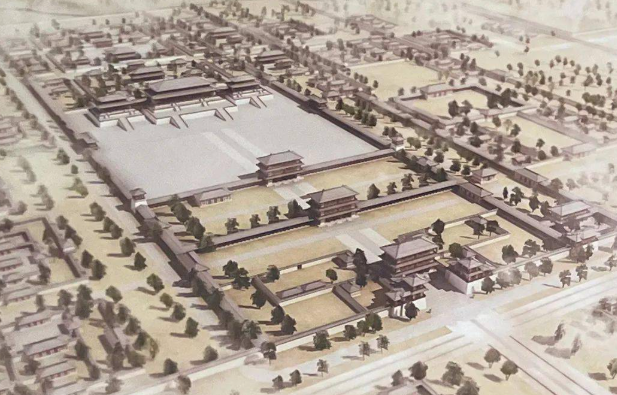
▲A visualization of the Han-Wei Luoyang City
The divergent fates of the two cities are etched into the archaeological record. Excavations at Han Chang'an reveal a palimpsest of explosive ambition: colossal palace foundations (the Weiyang Palace platform still stands 15 meters high), intricate bronze chariot fittings, and over 60,000 bone tallies—administrative records on animal bones detailing tributes of weapons and goods from across the empire, proof of its material and military reach.
At Eastern Han Luoyang, archaeologists find the tools of ideology and global connection: the precise foundations of Han's Imperial University, where fragments of the "Xiping Stone Classics"—state-sanctioned Confucian texts carved in stone—were found, meant to standardize learning. They uncover exquisite green-glazed ceramics and clay figurines depicting learned officials, reflecting a refined court culture. Most tellingly, they find Roman glassware, gold coins from the Byzantine Empire, and Persian silverware along the "Copper驼 Street," silent testaments to Luoyang's role as the eastern terminus of the Silk Road during this period, a cosmopolitan hub of ideas and commerce.
The historical and global significance of the Han dual-capital system is profound. On the one side, it provided the definitive model for managing a vast, geographically diverse empire. The Tang dynasty (618-907 AD) perfected this, using Chang'an (renamed) as the primary administrative capital and Luoyang as the secondary "Eastern Capital," crucial for grain supply and controlling the east. The system acknowledged that one city could not optimally serve all strategic, economic, and symbolic functions. On the other side, the Chang'an-Luoyang duality came to represent two enduring poles of Chinese statecraft: the strategic, militarized "power base" (exemplified by Chang'an) versus the civilian, ritualistic "heartland capital" (exemplified by Luoyang). This dialogue between "might" and "right," between control from a secure periphery and rule from the moral center, became a recurring theme in Chinese history.
Worldwide, while other contemporary empires, such as Rome, operated from a single mega-capital, the Han developed a sophisticated, polycentric model of imperial governance. This system facilitated stability over four centuries, protecting and projecting a civilization whose artistic, bureaucratic, and philosophical achievements would radiate across Asia. The Silk Road, which linked both Han capitals to the world, was as much a conduit for Han's institutional ideas as for its silk.
In the end, the two Han capitals were not rivals but partners in a grand imperial project. Chang'an, the "golden city," provided the sword and shield that forged and defended the empire. Luoyang, the "center of the world," provided the scepter and scroll that legitimized and civilized it. Together, as the twin pillars of the Han, they established a formula for longevity and legitimacy that would echo through the halls of power in China and in the study of empires everywhere, for a thousand years to come.
Related articles
-
 Heritage Grid | The Legacy of Chinese Academies: Education, Ethics, and a Dialogue with Athens
More
-
Zhongyuan: The main root and vein of Chinese civilization
More
-
Heritage Grid | The Sacred Peaks: How these Five Mountains Forged Chinese's Identity
More
-
Longmen Grottoes: The Peak of Chinese Stone Carving Art
More
-
Heritage Grid | The Silent Cities of Mangshan: China’s Valley of Kings
More
-
Yin Shang Culture: Yinxu, Oracle Bones and Bronze Ware
More