Heritage Grid | Camel City: The Silent Sentinel of China’s Ancient Silk Road
In the vast, windswept expanse of the Hexi Corridor in Gansu Province, a sprawling rammed-earth fortress has stood sentinel for nearly two millennia. What secrets does this Camel City hold? Why did a kingdom rise and fall within its walls—and how did it become one of the best-preserved Han-Tang ancient cities in all of China?
The Sleeping Giant of the Gobi
Located 20 kilometers southwest of Gaotai County, Zhangye City, the Camel City sprawls across an astonishing 307,700 square meters. Measuring 425 meters east to west and 704 meters north to south, it is widely recognized as China’s largest and best-preserved Han-Tang ancient cultural relic. From above, the fortress forms a distinct Ri (日) shape, comprising two cities separated by a central partition wall. This ingenious design created an integrated defensive chain of “partition wall–barbican–horse face–corner tower,” a four-in-one military system that turned the city into an almost impenetrable stronghold.
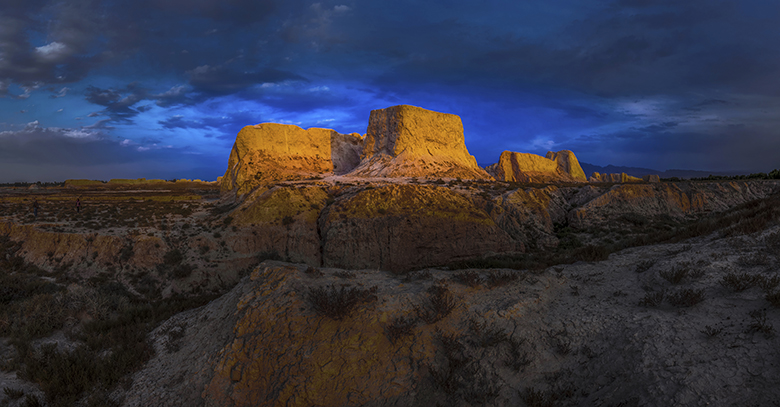
photo by Li Yulog, gaotai.gov.cn
How an Earthquake and a Fallen Kingdom Forged History
The story of Camel City is one of destruction, ambition, and resilience. In 180 CE, a catastrophic earthquake struck the Han Dynasty’s Biaoshi County. The earth shook with such violence that it rendered the original settlement uninhabitable, forcing survivors to rebuild on a new site—what we now know as Camel City.
Yet the city’s most dramatic chapter began in 397 CE, when Duan Ye, the Grand Administrator of Jiankang County, declared himself king and founded the Northern Liang Kingdom (Beiliang). Camel City became his capital. For thirty years, it served as the beating heart of this breakaway empire before political intrigue and shifting allegiances moved the capital elsewhere. By 766 CE, the city fell to Tibetan forces and gradually slipped into ruin, eventually becoming a natural camel pasture for passing caravans—hence its enduring name.
A Masterpiece of Military Architecture
What makes Camel City truly extraordinary is its layered defensive genius. The rammed-earth walls, standing up to 7.5 meters high in places, incorporate reeds and tamarisk branches between each 10–15 cm layer—a construction technique identical to that used at the legendary Yumen Pass and Hecang Fortress along the Great Wall. This “supreme-grade border defense code” demonstrates an astonishingly sophisticated understanding of structural engineering.
Inside the north city (nicknamed Imperial City), archaeologists have uncovered nine building foundations, including a large concentric Tang-dynasty architectural complex. Meanwhile, the surrounding tomb group—boasting over 7,000 Han, Wei-Jin, and Tang burials—ranks among the densest and best-preserved cemetery clusters in all of China.
Windows into a Lost World
The true glory of Camel City lies not in its ramparts but beneath the sands. Excavated painted bricks from Wei-Jin tombs offer a panoramic view of everyday life: men plowing mulberry fields, hunters chasing game across the steppe, merchants leading camels laden with exotic goods. Unlike the religious murals of Dunhuang, Camel City’s tomb art leans toward secular narrative—smaller, more intimate scenes that capture the vibrant, multicultural rhythm of Silk Road society. Some painted bricks even incorporate Hellenistic artistic motifs, proving that Greek cultural echoes reached as far as the Gobi Desert.