Three Hundred Tang Poems
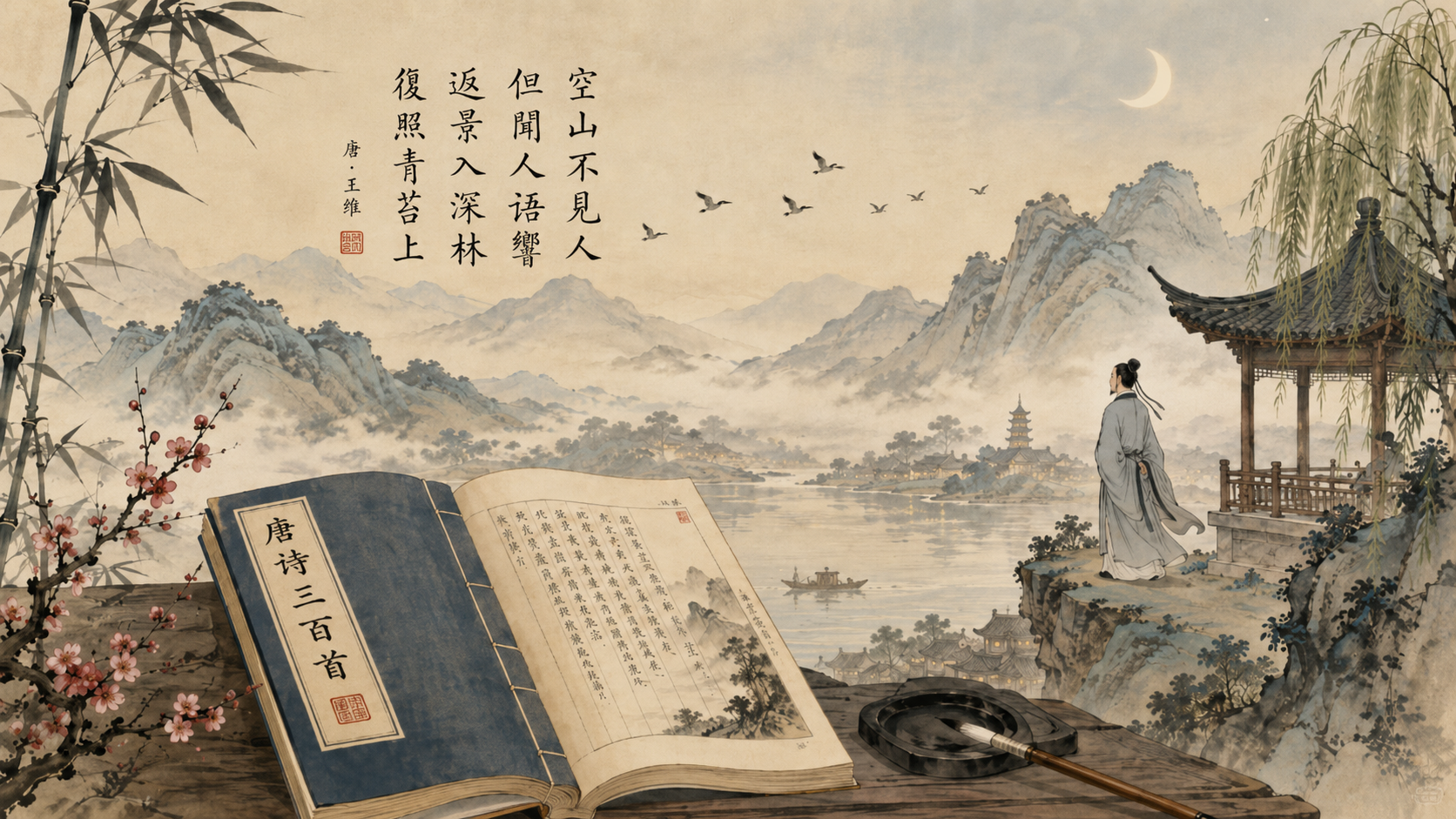
Three Hundred Tang Poems (唐诗三百首) is one of the best-known anthologies of classical Chinese poetry. It was compiled during the Qing dynasty by Sun Zhu, who used the literary name Hengtang Tuishi, and was first published in 1763. Despite its title, the collection contains slightly more than three hundred poems. Sun Zhu intended it as an accessible introduction to Tang poetry, produced during an age often regarded as the golden period of Chinese verse.
The anthology brings together several poetic forms, including ancient-style verse, regulated verse, and short quatrains in five- or seven-character lines. Its poets include Li Bai, Du Fu, Wang Wei, Meng Haoran, Bai Juyi, and Li Shangyin. Their works range from moonlit landscapes and mountain journeys to friendship, homesickness, war, court life, and the passing of time. A few carefully chosen images can open an entire emotional world: a lonely sail, falling leaves, frontier snow, or a bell sounding at night.
The collection became popular because its poems are memorable, varied, and suitable for reading aloud. For generations, children and adults learned many of them by heart. A familiar saying claims that someone who reads the Three Hundred Tang Poems thoroughly will learn to recite poetry even without knowing how to compose it. The anthology thus became more than a book; it helped shape shared expressions, images, and cultural memories throughout the Chinese-speaking world.
Today, Three Hundred Tang Poems remains a welcoming gateway to classical Chinese literature. It is not a complete survey of Tang poetry, but its selections reveal the remarkable range and refinement of the period. Through concise language and enduring emotions, these poems allow modern readers to hear voices from more than a thousand years ago—and to discover how closely their joys, losses, and longings resemble our own.