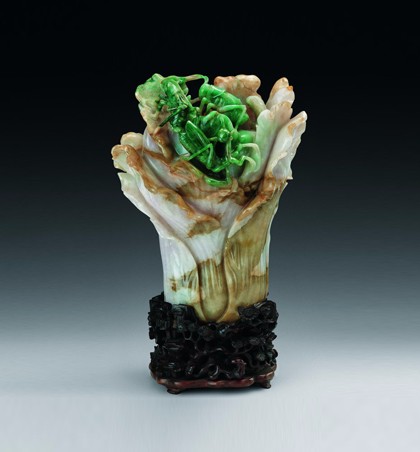
Jadeite Cabbage with Katydids
Of all the treasures in the Tianjin Museum, one of the most beloved is also one of the most surprising: a jade cabbage.
At nearly 20 centimeters tall, this Qing dynasty sculpture is carved from a single piece of jadeite—one of the hardest gemstones, ranking around 7 on the Mohs scale. What makes it extraordinary is how the artist worked with the stone's natural colors rather than against them.
The jadeite wasn't perfect. It had streaks of white, patches of green, and veins of brown. A lesser craftsman might have seen these as flaws. But the Qing dynasty carver saw opportunity. The white became the crisp stalk of a cabbage. The green, concentrated at the heart, became two plump katydids and a mantis, nibbling at the leaves. The brown? Those are the natural blemishes on the vegetable, made real.
This technique is called "qiao se"—literally "clever color"—and it requires both technical skill and artistic vision. Jadeite is so hard that carving it is painstaking work. Every cut is final. Yet the result here feels effortless: the insects seem alive, mid-crawl; the leaves curl with the weight of water.
The choice of subject was no accident. In Chinese culture, cabbage (baicai) sounds like "hundred wealth." Katydids, with their many offspring, symbolize fertility and good fortune. Together, they form a wish for prosperity and family—wrapped in a vegetable so ordinary, yet rendered in stone so precious.