Green Jade Winged Dragon Wine Vessel
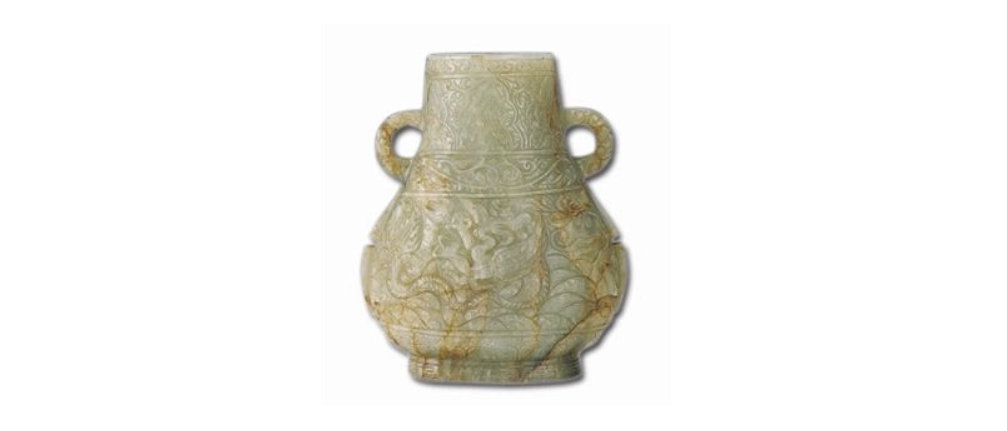
In the jade gallery of the Tianjin Museum, one object stands out for its rarity and power. This small wine vessel, carved from a single piece of green jade, is one of the very few surviving jade "hu" vases from the Yuan dynasty—a period when such vessels were exceptionally rare.
At first glance, the vase impresses with its rich layers of carving. Six distinct bands of decoration wrap around the body, from the lotus petals at the base to the leafy scrolls near the mouth. But the eye is drawn to the center: a winged dragon, muscles tensed, bursting from waves.
This is no ordinary dragon. It has the antlers of a deer, the scales of a fish, the wings of a bird, and a forked tail ending in a flaming pearl. With three claws extended, it surges upward through churning seas. The craftsman used a combination of relief carving and incised lines to capture both the creature's coiled energy and the roiling motion of the water below.
The vase's layered decoration—so dense and organized—mirrors the style seen on blue-and-white porcelain from the same period. This was a signature of Yuan dynasty design: complexity stacked upon complexity, yet always controlled.
The Yuan dynasty was China's first ruled by the Mongols. Yet rather than abandon native traditions, the new rulers embraced them—especially jade work, which they saw as a mark of prestige. They established official workshops and commissioned pieces like this one, likely for the imperial court. The result is an object that bridges two worlds: the nomadic energy of the steppe, captured in a dragon in flight, and the refined craftsmanship of China's ancient past.
Today, this vase is considered a masterpiece of Yuan jade carving—elegant, powerful, and utterly unique.