Zhengyang Gate
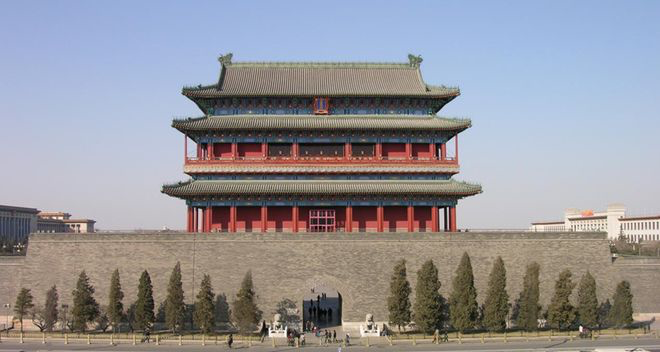
Zhengyang Gate, commonly known as Qianmen, stands at the southern end of Tian’anmen Square in central Beijing. It was the main southern gate of Beijing’s inner city during the Ming and Qing dynasties. Construction began in 1419 during the Yongle reign of the Ming Dynasty and was completed in 1439 during the Zhengtong reign.
Zhengyang Gate was built on a grander scale than the other eight gates of Beijing’s inner city and was known for its distinctive layout of four gates, three bridges, and five pailou. The four gates refer to its four openings, while the other eight inner-city gates each had only two. The three bridges refer to Zhengyang Bridge, which crossed the moat in front of the archery tower. Although it was a stone arch bridge, its broad surface was divided by railings into three passages. The central passage, aligned directly with the entrance to the archery tower, was known as the Imperial Way and was reserved exclusively for the emperor. The five pailou refers to the ceremonial archway in front of Zhengyang Gate. During the Ming Dynasty, all nine city gates had pailou, but Zhengyang Gate’s was the most imposing, spanning five bays. Today, it is the only one of the original nine city-gate pailou to have been reconstructed.
Zhengyang Gate is a historic example of China’s ancient defensive architecture and the only city gate in Beijing whose gate tower and archery tower remain well preserved. It is both an important historical and cultural heritage site and an outstanding embodiment of Beijing’s character as an ancient capital, with deep cultural significance. As an irreplaceable cultural relic, Zhengyang Gate conveys history through its silent architectural language and has distinctive value for the study of ancient architecture, culture and the arts, folk customs and rituals, and dynastic history. It is an important part of Beijing’s historic urban landscape and an iconic symbol of old Beijing.