
Heritage Grid |The Nanyue kindom: China's Early Maritime Hub and the Dawn of Globalization
In the heart of modern Guangzhou, a layered history of an ancient kingdom lies preserved, earning the title of the Eastern Pompeii for its remarkably stratified urban ruins.
In 1983, a construction crew on Xianggang Hill stumbled upon a tomb sealed for over two millennia. Its occupant, undisturbed by looters, was surrounded by treasures. This was the resting place of Zhao Mo, the second king of the Nanyue Kingdom, whose rule from 137-122 BCE left a lasting mark on southern China. Just over a decade later, in the city's center, the remnants of his royal palace emergedse tradition with foreign influences, revealing a culture that masterfully blended China, serving as a crucial hub on the early Maritime Silk Road.
The Sealed Tomb
The 1983 discovery of the Nanyue Wenwang Mausoleum was a significant archaeological find. Unlike many ancient royal tombs, it was found completely intact, a time capsule from the 2nd century BCE.
Covering approximately 100 square meters, it mimics the "front court, rear chambers" (前庭后院) layout of a palace, with the front section symbolizing the public audience hall and the rear housing the king's private quarters.
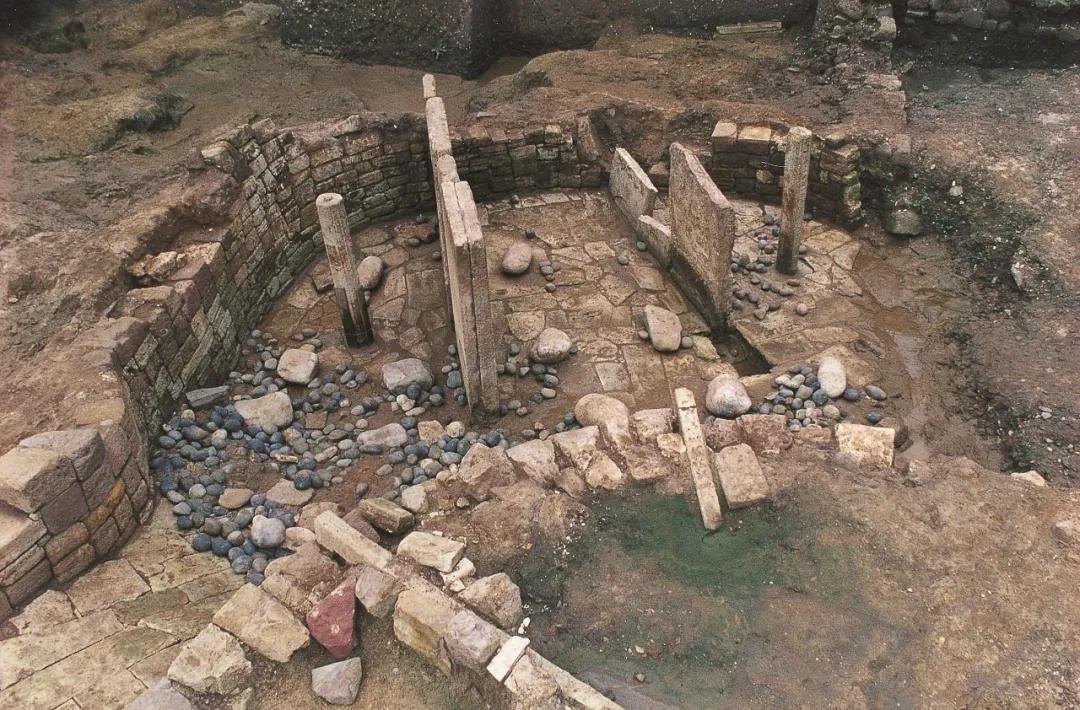
▲ The legacy of the Nanyue Kingdom
The occupant was confirmed by two seals: an Emperor Wen gold seal with a dragon knob—the largest Western Han gold seal found to date—and a Zhao Mo jade seal. Among the over 1,000 burial objects, the most extraordinary is his silk-threaded jade burial suit, an intricate funerary garment made of thousands of jade pieces connected by silk, predating the famous gold-threaded suits of Mancheng by about a decade. The tomb also contained artifacts revealing a sophisticated kingdom, including the earliest known patterned bronze mat for silk printing, maritime-themed bronze vessels, and even imported luxuries such as African ivory and Middle Eastern frankincense.
The Palace and Garden
While the tomb revealed a king's afterlife, the discovery of the Nanyue Kingdom Palace and Administrative Office Site, beginning in earnest in 1995, unveiled the political and cultural heart of his realm.
Layered History: The site is a historical palimpsest. Excavations revealed 12 continuous historical layers, from the Qin dynasty to the Republic of China, piled nearly 6 meters deep. At its core are the earliest preserved palace garden ruins in China, dating back to the Nanyue Kingdom.
A Fusion of East and West: The royal garden features a winding Curved Stone Channel and a large stone reservoir, creating a miniature, landscaped watercourse—a classic expression of Chinese garden aesthetics that seeks harmony with nature. Yet, its construction is strikingly international. The stonework employs techniques like rubble masonry (using irregular stones), similar to that found in ancient Greek structures like the Apollo Temple wall. The discovery of octagonal stone columns, rare in ancient China but common in Greco-Roman and South Asian architecture, and alkaline-glazed tiles whose chemical composition resembles Western glass, points to significant early technological and cultural exchange.
The palace complex, covering about 150,000 square meters, was the two-thousand-year center of the Lingnan region, serving successive dynasties and bearing witness to the city's unbroken urban life.
The Founder: Zhao Tuo and the Legacy of a Kingdom
The story of these ruins begins with Zhao Tuo, a Qin dynasty general. After the Qin collapse, he consolidated control over the Lingnan region (modern Guangdong, Guangxi) and founded the Nanyue Kingdom in 203 BCE, with Panyu (Guangzhou) as its capital.
Ruling for 67 years, Zhao Tuo was a masterful strategist. He initially declared himself king but later pragmatically submitted to the Han dynasty, securing peace and autonomy. His policies promoted the integration of Han immigrants with local Yue communities, accelerating agricultural and societal development in the region and earning him recognition as a pivotal figure in Lingnan's history.
After 93 years and five kings, internal strife led to the kingdom's annexation by the Han Emperor Wu in 111 BCE. Despite its end, the Nanyue Kingdom's century of independent development laid a durable foundation for Guangzhou's future as a permanent center of trade and cross-cultural interaction.
The Nanyue sites are far more than local treasures. They are key pieces of evidence for understanding early globalization.
Seafaring Pioneers: The artifacts—from imported goods like frankincense to ship motifs on bronzes—prove the Nanyue people were adept seafarers. They likely utilized seasonal monsoon winds to trade along the coasts of Southeast and South Asia, acting as pioneers of the Maritime Silk Road centuries before it reached its peak. Their capital, Panyu, became a thriving port where pearls, silks, and spices were exchanged.
Today, the Nanyue Palace Museum and the Mausoleum Museum preserve these sites, transforming them into bridges that connect the public with this rich past.
Related articles
-
 The Hakka: Nomads of Wisdom, Builders of Tomorrow
More
-
Cantonese Opera: Where Tradition Whispers through Neon Lights
More
-
Dim Sum Culture: Where Steamed Baskets Brew Stories
More
-
The Soul of Shaoguan: Where Mountains Whisper Tales of Lingnan
More
-
Guangdong Lion Dance: a Dance of Myth, Muscle and Community Spirit
More
-
Chaoshan Culture: a Symphony of Heritage, Flavor and Global Resonance
More