Voices from the Han Frontier
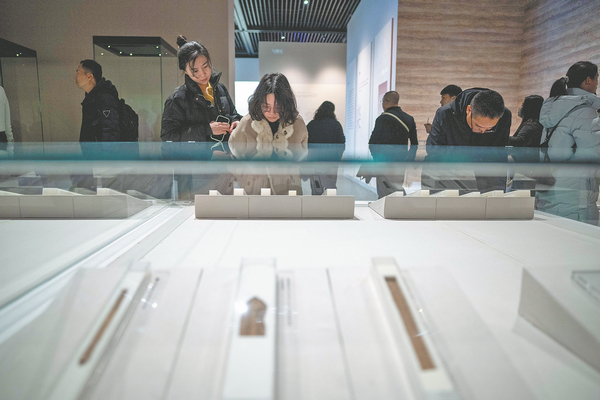
▲Han Dynasty (206 BC-AD 220) slips are the focus of an ongoing exhibition at the Inner Mongolia Museum in Hohhot. LIAN ZHEN/XINHUA
Unearthed in the deserts of Juyan, thousands of wooden slips document nearly four centuries of military, economic and social life, Deng Zhangyu and Yuan Hui report in Hohhot.
At the display case of the Inner Mongolia Museum in Hohhot, Inner Mongolia autonomous region, visitors lean in to gaze at a wooden slip about 23 centimeters long. The ink characters on it are still clear, spelling out a message in Chinese from 2,000 years ago — a "plea for help" from Yuan Chang, a low-ranking border fortress clerk, to his friend Zi Hui. Unable to mend his torn clothes on his own, he earnestly asked his friend to lend him an old short garment.
"Doesn't it feel like texting a friend today to borrow some clothes?" asks Zhao Yuan, director of the Alshaa Museum who helps organize the show.
Not far away, on an interactive screen, this very text is being brought to life through AI animation: a ragged Yuan Chang wringing his hands and sighing, while Zi Hui rummages through a chest to find an old robe. The vivid scene makes the awkwardness and warmth from two millennia ago feel present and relatable.
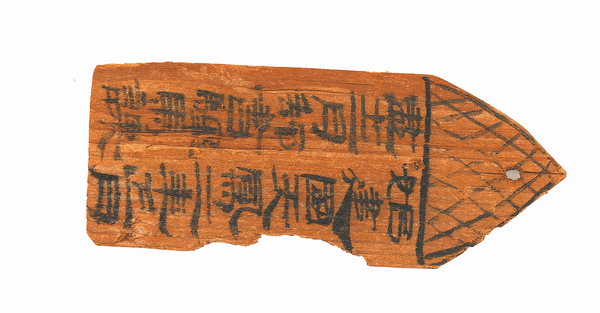
▲Two Han Dynasty slips of different lengths from the Gansu Jiandu Museum are on display at the exhibition. CHINA DAILY
Juyan, located in Ejine Banner in the Inner Mongolia autonomous region's Alshaa League, was once a key stop and military stronghold on the ancient Silk Road. A large number of soldiers were stationed there year-round to guard against invasions, Zhao explains.
A special exhibition at the Inner Mongolia Museum focuses on Hanera slips unearthed from the Juyan region. The exhibition through March 15 features about 400 items, including Juyan wooden and bamboo slips, artifacts and documents, divided into six thematic sections. They span from daily life in Juyan during the Neolithic Age to the armed frontier culture of the Han Dynasty (206 BC-AD 220).
What resonates most emotionally are the records of everyday life behind these wooden slips — they are the Han Dynasty's leave requests, shopping lists and family letters, forming a kind of encyclopedia of daily life written on wooden tablets.
"Each Juyan wooden slip is hard-won," says Wei Jian, director of the Institute of Chinese Borderland Studies of the Chinese Academy of Social Sciences. As one of the archaeologists involved in excavating the Juyan slips, he once endured sandstorms and searched under the scorching sun, all to bring these long-buried wooden slips back to light after a millennium of sleep.
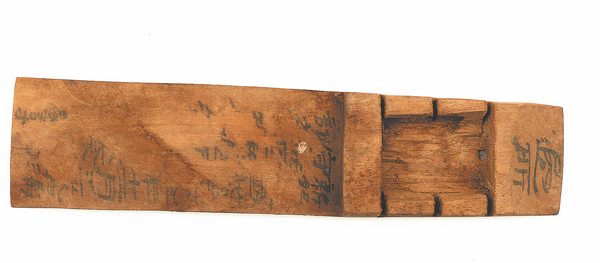
▲Two Han Dynasty slips of different lengths from the Gansu Jiandu Museum are on display at the exhibition. CHINA DAILY
Since the 20th century, approximately 40,000 Han Dynasty slips have been unearthed at Juyan site. Their contents span from 128 BC to AD 283, covering nearly 400 years and providing invaluable material for studying the politics, economics and military affairs, and social life of the Han Dynasty.
The discovery history of the Juyan slips is also a story of efforts by scholars from China and abroad. In 1927,Swedish archaeologist Folke Bergman joined the Sino-Swedish Northwestern Scientific Expedition, and in 1930 he excavated over 10,000 wooden slips. Subsequently, from the 1960s to the 1980s, tens of thousands more slips were unearthed in large-scale excavations. Between 1998 and 2004, Wei's team discovered over 500 additional slips during archaeological work in Juyan.
"In the Badain Jaran Desert of Inner Mongolia, sandstorms can strip the paint off a vehicle," Wei recalls of one excavation experience."That day was sunny and bright, but suddenly the sky turned dark. A mountain of sand rolled toward us, and the vehicle was pounded. After more than 20 minutes, when the sandstorm subsided, we found the green paint on the rear window completely gone."
In this "sea of death", where annual rainfall is less than 40 millimeters, the archaeological team persevered for almost seven years.
What Wei remembers most vividly is a specially sized wooden slip found in the spring of 1998. "We found an old wooden stick in the rubble of a beacon tower. We gave it a kick, and it moved. When we pulled it out, it turned out to be a Han slip carved on six sides," he explains with a smile.
"It recorded that a soldier named Wang Xuan bought 170 bundles of licorice at one coin per bundle. Having no money at the time, he promised to repay the debt when he received his salary in the third month. This isn't just a cultural relic. It's clearly a 2,000-year-old pay stub and IOU!" Wei says.
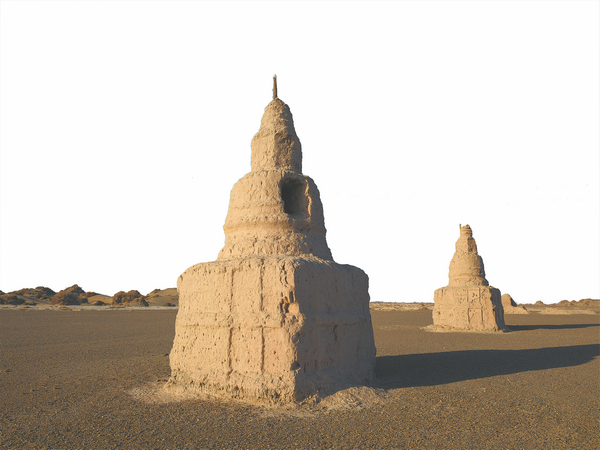
▲Towers from the Xixia Dynasty (1038-1227) stand at the Juyan site, in Ejine Banner in the Inner Mongolia autonomous region. MA JINRUI/XINHUA
Even more interesting is the "hierarchy" of the slips. Wei notes that Han Dynasty slips had strict regulations regarding dimensions: those for recording laws, those for recording the words of sages, those for commoners, and those for the emperor — all had different sizes.
"Such strict regulations reflect the order and rituals of Han society," he says.
More than 200 artifacts in this exhibition come from the Gansu Jiandu Museum in Lanzhou, Gansu province. Chang Yanna, who has studied Juyan slips for decades and is an expert at the museum, also participated in preparing this exhibition.
She explains that the slips unearthed at Juyan are not only astonishing in quantity but also renowned as an "encyclopedia of content". They include official documents such as government decrees and military deployments, private documents like family letters and IOUs, as well as texts for soldiers and officials to study, and account books detailing grain and fund allocations or price fluctuations. They cover almost every aspect of society at the time.
"One slip records how much grain is allocated for men, women and children, reflecting the grain ration system at the frontier. Another notes the price of licorice — which varied in different months and years — making it the earliest 'price fluctuation chart'," Chang says.
Records concerning the "beacon fire system" on the slips also demonstrate the military wisdom of the Han Dynasty. Chang points out that 17 slips unearthed at Juyan detail regulations such as how many beacon fires to light based on the number of approaching invaders, the distances involved, and how to ignite the fires.
"This isn't just a simple military arrangement. It's a mature information transmission system," says Chang.
To make these "silent wooden slips" speak, the exhibition employs extensive digital technologies. Interactive screens in the hall divide the stories from the wooden slips into 17 engaging themes, using AI animation to recreate scenes of daily life in the Han Dynasty.
In the slip restoration experience zone, visitors can personally restore a damaged wooden slip through AR technology. An interactive calligraphy evolution installation allows visitors to intuitively experience the transformation of Chinese character styles.
The exhibition hall uses animated short stories to depict aspects of life back then, such as handling debt disputes, private transactions, and even sending what appear to be express deliveries. These are paired with period-appropriate daily utensils — like straw sandals similar to modern flip-flops, spoons used for eating, and the seeds of foods introduced from the West at that time — all designed to immerse visitors as much as possible in the arduous life of frontier garrison troops 2,000 years ago.
"We aim not only to display the Han slips, but also to transport visitors back to the Han Dynasty," says curator Zhao.
Ma Jingna in Lanzhou contributed to this story.
Contact the writers at dengzhangyu@chinadaily.com.cn