Springboard – A Traditional Korean Ethnic Sport
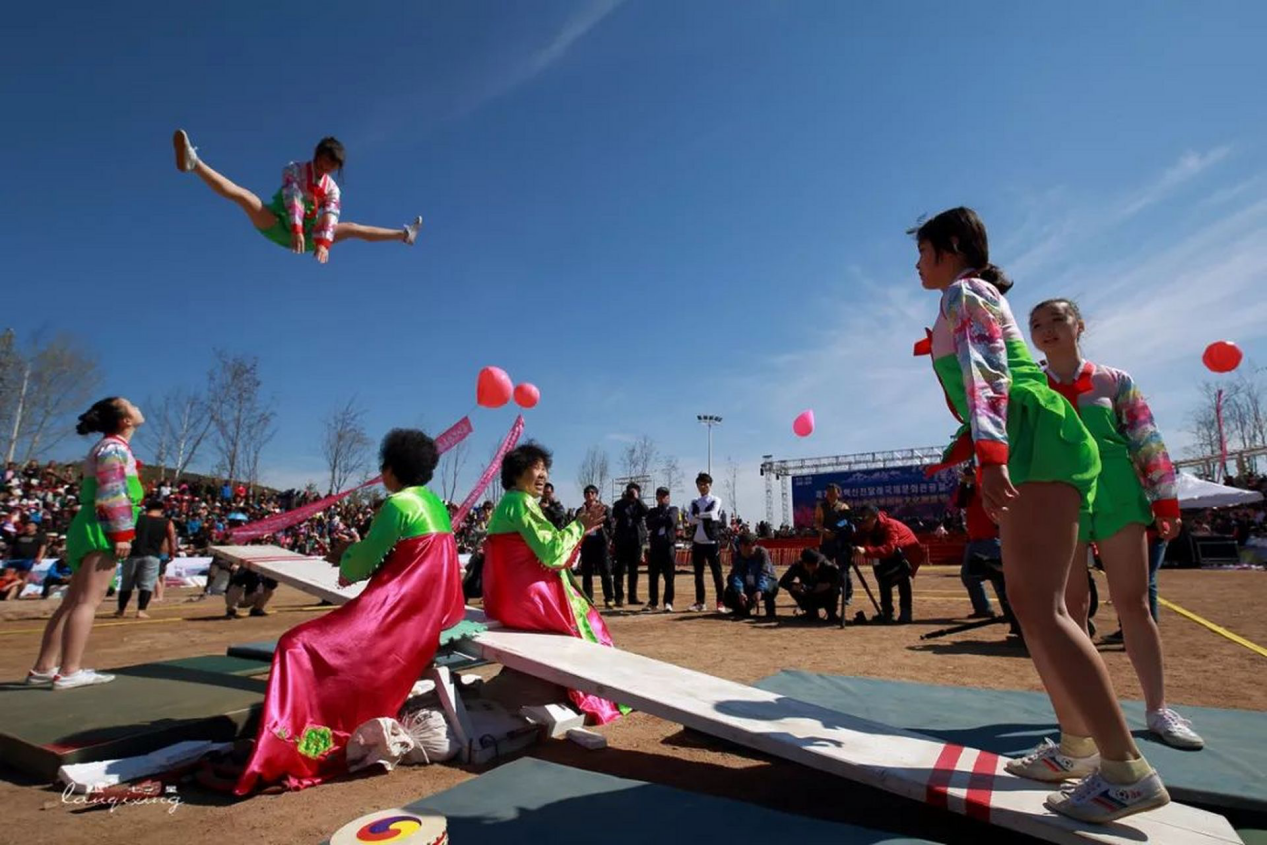
Springboard jumping has evolved from a folk game into a formal competitive ethnic sport. It is one of the traditional games widely enjoyed by Korean ethnic women and has a long history. It is generally performed during festivals such as the Lantern Festival, Dragon Boat Festival and Mid-Autumn Festival. The sport is practiced in Yanbian Korean Autonomous Prefecture in Jilin Province and other areas across China where Korean ethnic communities live.
The springboard is generally made of willow wood, which is both hard and highly elastic. A support is placed beneath the center of the board to serve as a fulcrum, allowing both ends to move up and down. During a jump, two participants stand at opposite ends and take turns jumping, using the board's rebound to propel themselves and each other into the air. Repeatedly rising and falling, they strive to jump higher while performing a variety of movements in mid-air. The sport requires close coordination between the two participants. Sometimes they even sing as they jump, with one leading the song and the other responding.
Springboard competitions are divided into two types: string-pulling and performance skills. In the string-pulling event, the winner is determined by the length of the string pulled out by the airborne jumper from a string tied around the ankle within a specified time. In the performance event, participants are judged on a combination of height, aerial movements, posture and skill. The winner is the participant who performs the most difficult yet graceful movements.
Springboard jumping is an effective way to enhance leg power and aerial balance, while also helping develop physical form and grace. It requires considerable strength, endurance, balance and flexibility. It demands not only skill and technique, but also courage. Watching a springboard performance is a visually captivating experience that often leaves spectators full of admiration.