Tianning Temple Pagoda: Beijing's Oldest Standing Monument
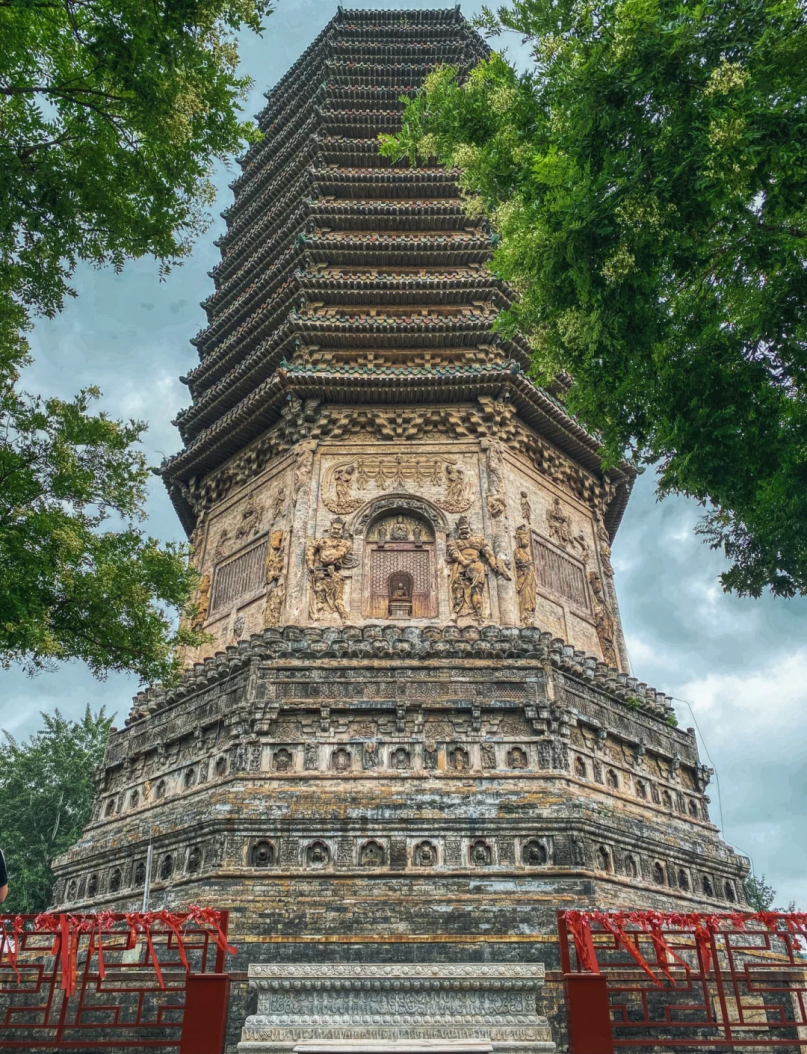
The Tianning Temple Pagoda, located outside Guang'anmen in Beijing, is the oldest complete standing architectural monument among the city's temple pagodas, both within and beyond the old city walls.
This pagoda belongs to a distinctive architectural type. Its ground plan is octagonal, it is built of solid brick, and its exterior is divided into three principal sections: a high base, a single-story pagoda body, and multiple tiers of closely spaced eaves above.
Pagodas of this type have remarkably graceful silhouettes—stable yet soaring. The projecting layers of eaves create alternating patterns of light and shadow, while the stacked eaves contrast strikingly with the plain pagoda body, producing a visual effect that is especially impressive when viewed from afar.
The pagoda body is slightly narrower between the base and the eaves, giving it a particularly elegant and slender appearance. The base is equally striking, with its alternating projecting and recessed forms. From a distance it appears crisp and well-proportioned; up close, visitors can appreciate exquisite relief carvings of floral motifs, mythical beasts, and human figures. These carvings are exquisitely detailed and vividly lifelike, achieving the richest decorative effect. This represents an invaluable artistic achievement in Chinese brick architecture.
Judging from their geographical distribution and historical context, pagodas of this type were the result of the joint efforts of Khitan builders—whose descendants later became part of the ancestors of the Manchu people—and Han craftsmen who had migrated to the Liao region. Together, they made a significant contribution to China's architectural heritage. Having withstood more than nine centuries, the Tianning Temple Pagoda remains a complete and magnificent monument and stands today as one of Beijing's most treasured artistic landmarks.