The Roof Guardian: Yunnan's Tile Cats
The Yunnan Tile Cat may sound like an ordinary feline decoration, but it is actually a unique ceramic or stone mythical creature placed on the ridges of traditional Yunnan houses. Despite its name meaning "cat," its prototype is in fact the tiger, whose formidable strength is invoked to guard the home. In the past, people believed that placing it on the main roof ridge, eaves, or above the main gate could ward off evil, protect the household, and attract good fortune, ensuring the family's safety and harmony.
The charm of the Tile Cat lies in its highly imaginative folk artistry. There is no uniform standard; each piece is freely created by local artisans. As a result, Tile Cats come in a thousand forms: some bare their teeth, glare fiercely, and bear the character for "king" (王) on their foreheads, appearing majestic and fierce; others have wide, skyward-facing mouths in exaggerated and bizarre shapes; still others have been adapted for modern tastes, appearing simple and adorably clumsy. Making a traditional ceramic Tile Cat involves key steps like mixing clay, shaping the body, drying, and kiln-firing, often done in the same kiln as bricks and tiles.
Today, with fewer traditional tiled roofs, the clever Tile Cat has "jumped" from the rooftops into modern life. Recognized as a provincial-level intangible cultural heritage, artisans continuously innovate its design. The Tile Cat image now appears on various cultural and creative products like refrigerator magnets, key chains, tea sets, and coffee cups, becoming a popular specialty souvenir among tourists. On the Kunming metro, you might even spot cartoon characters from the Tile Cat Family.
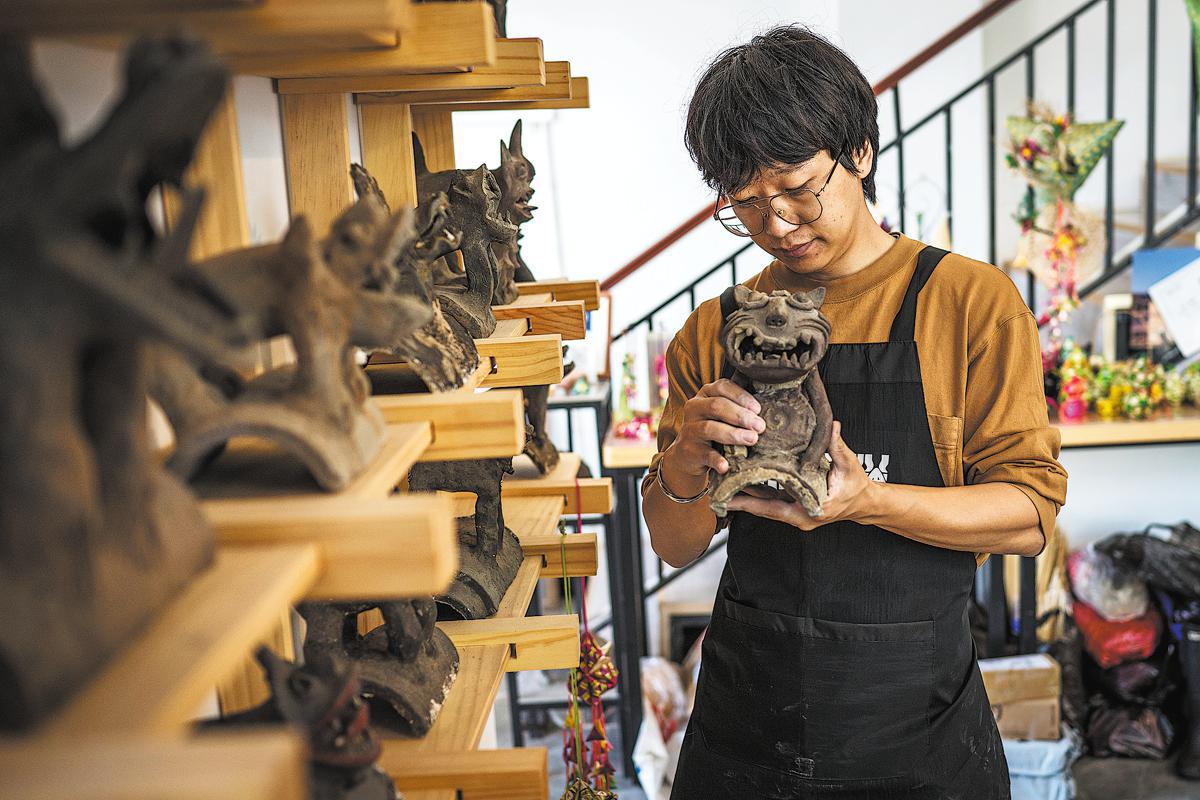 Zhang Hang examines a wamao at the Heart Chamber Wamao Museum in Kunming, Yunnan province. WANG GUANSEN/XINHUA
Note: If you'd like to learn more about Tile Cats, you can visit the Tile Cat Museum in Kunming's Longquan Ancient Town, which houses nearly 400 Tile Cats from different periods and in various forms.