
Heritage Grid | Before Panama, China Built the World's First Canal Lock 2200 Years Ago
Imagine a waterway so ingeniously designed that it allowed boats to climb over mountains, connecting two of China's greatest river systems. The Lingqu Canal (灵渠), also known as the Xing'an Canal, achieves precisely this remarkable feat. Built in 214 BC during the Qin Dynasty, this ancient hydraulic engineering project has been flowing continuously for over 2,200 years — a testament to its extraordinary design and enduring functionality.
Today, visitors can still witness the ancient water conservation system in action.
The Birth of an Engineering Legend
In 221 BC, after unifying China's warring states, the ambitious Qin Dynasty set its sights on the southern territory of Lingnan. Military campaigns faltered as supply lines stretched thin across treacherous mountainous terrain. The logistical challenge seemed insurmountable until an ingenious solution emerged: create a water connection between two separate river systems.
The Xiang River (湘江), flowing north toward the Yangtze River basin, and the Li River (漓江), running south into the Pearl River basin, came remarkably close in the Xing'an region — separated by just a low-lying watershed. Engineers realized that with careful planning, they could link these waterways and revolutionize military logistics.
Led by engineer Shi Lu, thousands of workers embarked on an ambitious project to "cut through mountains and connect waters." Within just four years, they completed what would become one of China's most significant ancient infrastructure projects. The canal's completion enabled the Qin army to transport troops and supplies directly by water to the southern front, facilitating their successful conquest and the subsequent integration of Lingnan into the finally unified China.
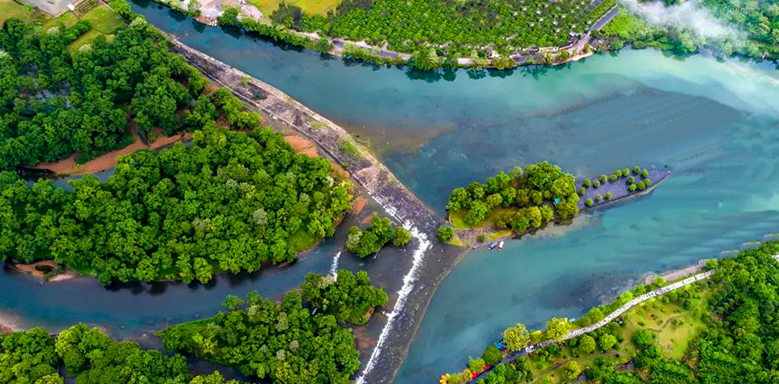
▲The Lingqu Canal's V-shaped structure
Ancient Hydraulic Genius in Design
What makes the Lingqu Canal truly remarkable is its sophisticated yet elegant engineering, featuring several innovations that would not appear elsewhere for centuries:
1. The Three-Seven Water Distribution System
At the canal's heart lies the Huazui (铧嘴), meaning plowshare tip — a V-shaped stone structure that divides the Xiang River waters. Its precise angle creates what engineers call the three-seven split: approximately 30% of the water flows south into the Li River, while 70% continues north along the Xiang River. This delicate balance ensures both rivers maintain adequate water levels throughout the seasons.
2. World's First Navigation Lock System
Perhaps the most revolutionary feature of the Lingqu Canal is its Doumen (陡门) system — the world's earliest known navigation locks. These adjustable wooden gates, placed at intervals along the canal's steepest sections, allowed boats to "climb hills" by creating temporary stepped pools of water. When a ship needed to ascend, the gate behind it would close, the section between gates would fill with water, and the ship would rise to the next level. This ingenious system, which some have called "the father of all ship locks", predates similar technology in the West by nearly two millennia.
3. Self-Regulating Flood Control
The Great and Small Balance (大小天平) dams, constructed from interlocking stone blocks, function as automatic spillways. During normal flow, they direct water into the canal, but when floods occur, excess water flows over the top, preventing damage to the canal system — an early example of passive flood management technology.
Political, Economic, and Cultural Significance
Firstly, to unify a divided nation: Beyond its military origins, the Lingqu Canal became a vital cultural and economic artery linking central China with southern regions. For centuries, it served as the primary transportation route between the Yangtze and Pearl River deltas, facilitating not just troop movements but also the exchange of goods, ideas, and people.
Secondly, to connect the Silk Road: Recent archaeological discoveries along the canal, including a 15cm tall Han Dynasty pottery figurine with distinctive Western Asian features found in 1983, provide tangible evidence that Lingqu served as a crucial link between land and maritime Silk Road routes. The figurine's Central Asian appearance suggests the canal was part of an extensive trade network connecting China with distant civilizations.
Thirdly, to benefit the continuous agricultural: Even after its transportation role diminished with the advent of modern railways in the 1930s, Lingqu continued to serve local communities. To this day, it irrigates approximately 6,500 acres of surrounding farmland, demonstrating how ancient infrastructure can remain functionally relevant across millennia.
Lingqu in World History
When considering the world's great canals, people typically think of modern engineering marvels like the Panama Canal (completed in 1914) or the Suez Canal (modern version completed in 1869). However, these achievements represent the culmination of a tradition that began with Lingqu more than 2,000 years ago.
While the Panama Canal stretches approximately 82 kilometers — more than twice Lingqu's 36.4 kilometers — and handles massive ocean-going vessels unimaginable to Qin Dynasty engineers, its fundamental challenge mirrored Lingqu's: moving boats across significant elevation changes. The solution at Panama — a system of massive locks — essentially represents a technological evolution of the Doumen system first implemented at Lingqu.
What sets Lingqu apart in world engineering history is its continuous operational longevity. Unlike many ancient structures that fell into disuse, Lingqu has served various functions — military transport, commercial artery, irrigation source, and now cultural heritage site — for over two millennia. This sustainable adaptability offers valuable lessons for modern engineers designing infrastructure meant to last.