Liangdu Fu - Rhapsody on the Two Capitals
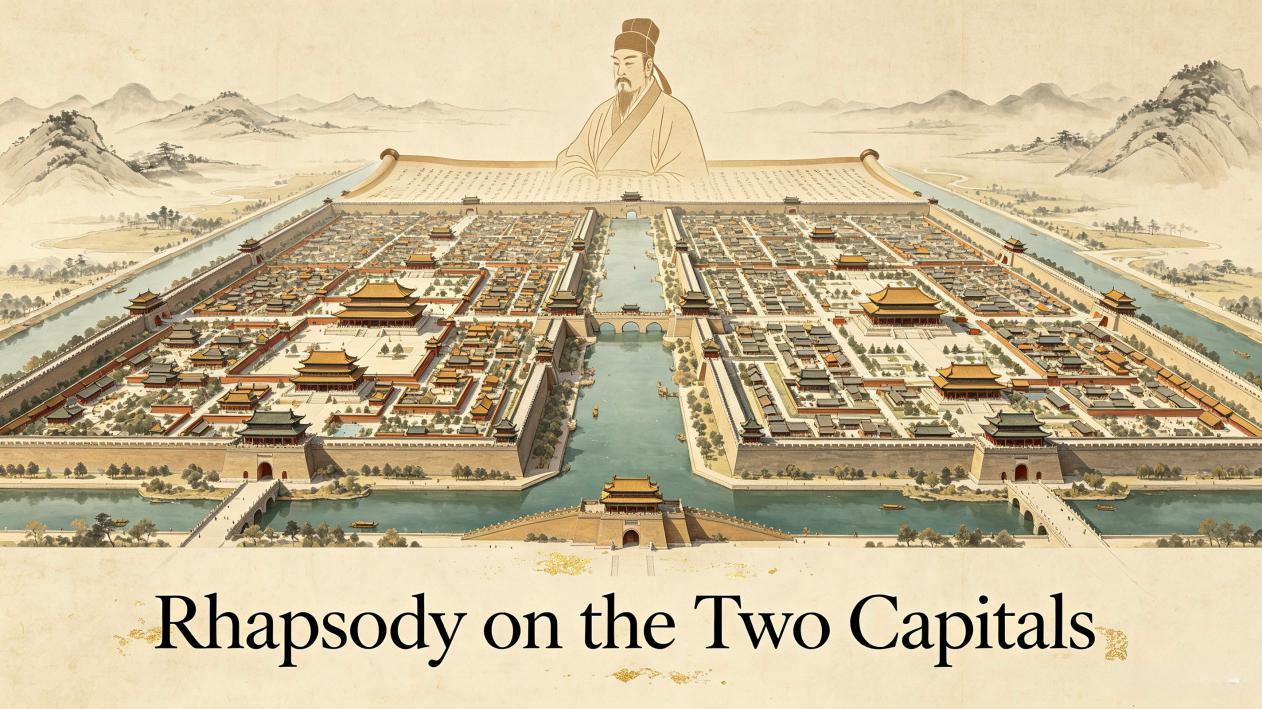
Among the prominent fu (rhapsody) writers of the early Eastern Han Dynasty, Ban Gu (32–92) stands out as both a historian and a master of fu literature. His best-known work is Liangdu Fu (Rhapsody on the Two Capitals).
The Two Capitals refer to Chang'an, the Western Capital, and Luoyang, the Eastern Capital. Liangdu Fu consists of two sections: Rhapsody on the Western Capital and Rhapsody on the Eastern Capital. Although Luoyang served as the capital of the Eastern Han Dynasty, there was once considerable debate over which city should be regarded as the superior capital. Ban Gu clearly endorsed Luoyang. Structurally, he followed the model of Sima Xiangru by presenting his ideas through a dialogue between opposing viewpoints.
Rhapsody on the Western Capital primarily extols the prosperity and splendor of Chang'an, including the luxurious lifestyle of the ruling elite. Rhapsody on the Eastern Capital, by contrast, praises the sound governance of the Eastern Han court, the majesty of the dynasty, and the honesty and simplicity of Luoyang's customs, suggesting that Eastern Han rule was more closely aligned with Confucian ideals than that of the Western Han. This comparison reflects the profound influence of Confucian thought on fu literature.
The hyperbole in Rhapsody on the Two Capitals is grounded in realistic description. Centered on portraying the metropolis, it vividly depicts every aspect of urban life, including mountains and rivers, plants and trees, birds and beasts, treasures, cities, palaces, streets, commerce, clothing, and people. The work is carefully structured, and its language is meticulously crafted. The capital-city fu became an important subgenre of Chinese rhapsodic literature, and its basic form was established by Liangdu Fu.