The Balanced Harmony
Tai Chi, or Taijiquan, is a centuries-old Chinese martial art characterized by slow, graceful movements paired with deep breathing and mindfulness.
Originating in ancient China and with almost 400 years of history, Taijiquan is deeply nourished by traditional Chinese philosophies and health-preservation concepts, such as the cycle of yin and yang, and the harmony between humanity and nature.
Through the coordination of movement, breathing and thought, Taijiquan embodies the interplay of motion and stillness, openness and closure, strength and gentleness, as well as real and feigned force, reflecting an ancient Chinese understanding of the universe and the human body.
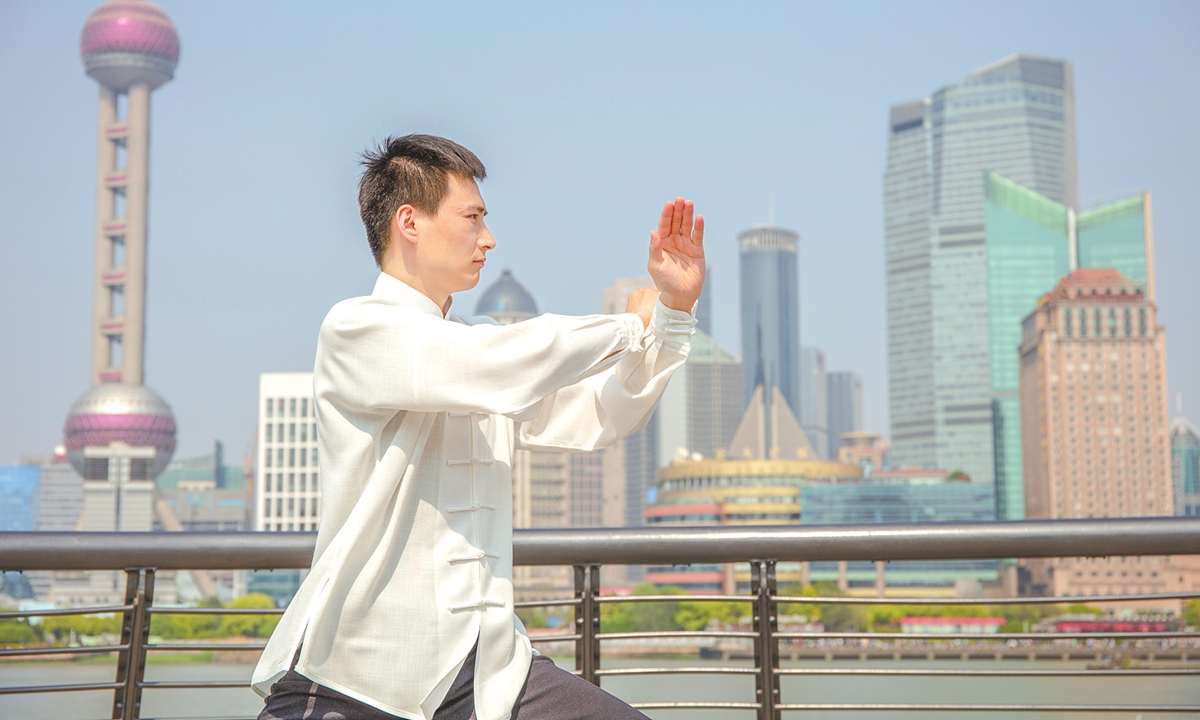
A man practices Taijiquan in Shanghai. Photos: VCG
Influenced by Taoist and Confucian philosophy and theories of traditional Chinese medicine, it has evolved into several schools over many centuries, including Chen, Yang, Wu and Sun styles, each carrying its own lineage and techniques.
Today, Taijiquan is a familiar sight in parks and public squares around the world and a celebrated part of international sporting events such as the World Games, World University Games, Asian Games and World Wushu Championships.
Recognized by the United Nations Educational, Scientific and Cultural Organization (UNESCO) as an intangible cultural heritage of humanity in 2020, Taijiquan has reached more than 180 countries and regions.
With UNESCO's approval of a resolution on November 5, 2025 designating March 21 as International , this centuries-old art form has a day of its own to be celebrated around the world.
The choice of date is highly symbolic. March 21 marks around the time of the spring equinox, one of the 24 solar terms in the traditional Chinese calendar, when day and night are of equal length. This balance mirrors the principles of yin-yang balance and harmonious coexistence in Taijiquan.