
Heritage Grid | The Loyal Guardian: Yuan Chonghuan‘s Tomb and the She Family’s Century-Long Vigil
In the heart of modern Beijing’s bustling Dongcheng District, tucked behind apartment buildings and a bank, lies a quiet memorial that has witnessed nearly four centuries of history—and a promise kept for seventeen generations. Who was the man buried here, and why did a single family devote its entire bloodline to guarding his grave, generation after generation?
The answer lies in one of the most tragic and controversial episodes of Chinese history: the fall of a patriot betrayed by the very emperor he died to protect.
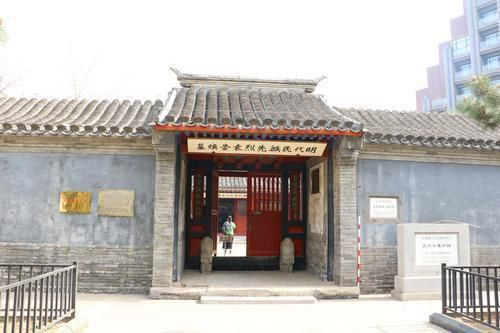
Yuan Chonghuan's tomb in Beijing
A General of Genius, A Death of Horror
Yuan Chonghuan (1584–1630) was a man of contradictions—a scholar-official who became a military genius, a southerner from Guangdong who rose to defend the frozen frontiers of the northeast. After passing the imperial examinations in 1619, he volunteered for the Liaodong front, and within a few short years, he had built the Guan-Ning-Jin defensive line and shocked the Manchu world by defeating Nurhaci himself at the Battle of Ningyuan (1626)—the first major Ming victory in decades.
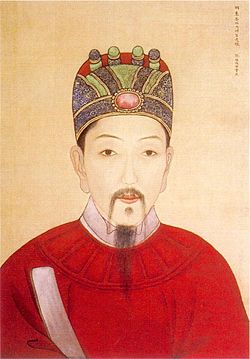
The portrait of Yuan Chonghuan
Yet Yuan was a tragic figure. Accused of treason through a clever ruse planted by Huang Taiji, he was arrested and condemned to the most brutal punishment imaginable: lingchi—death by a thousand cuts. On September 22, 1630, the man who had single-handedly held the Manchus at bay was publicly dismembered at Ganshiqiao in Beijing. His head was put on display; his flesh was reportedly torn apart and consumed by an angry mob who believed him a traitor. For a man who had famously declared, “I have devoted my life to the country; death I no longer fear,” the reality was far more savage than any poetic vision.
A Secret Burial and a Sacred Oath
But the story does not end in blood and betrayal. That same night, one of Yuan's most trusted subordinates—a man known only as She Yishi (literally, the righteous man named She)—risked his own life, stole the decapitated head of his commander from the execution ground, and buried it in the Guangdong Cemetery just inside Guangqumen, on the site of what is now 52 Donghuashi Byway. She's act of defiance planted the seed of one of the most extraordinary sagas of loyalty in Chinese history. She Yishi, swore a solemn vow to guard the tomb for as long as his bloodline endured. His descendants kept that promise for nearly 400 years, tending the grave through the fall of the Ming, the rise of the Qing, and the upheavals of modern China, all the way down to She Youzhi, the 17th-generation caretaker, who died in 2020.
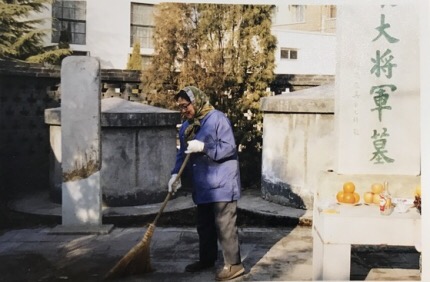
She's 17th generation was sweeping the tomb of Yuan Chonghuan
The Site Itself: Humble Yet Monumental
The Yuan Chonghuan Tomb and Shrine originally covered an area of 12,800 square meters, facing south in accordance with Chinese geomantic traditions. Today, the complex consists of a modest ancestral hall (five bays wide) and the tomb mound behind it, ringed by a brick wall and cypresses. Inside the hall, a portrait of the general greets visitors, while the walls are adorned with stone inscriptions that speak to centuries of veneration. The most important artifact is the tombstone itself: “The Tomb of Great General Yuan of the Ming Dynasty,” inscribed in 1831 by Wu Rongguang, the Governor of Hunan and a fellow Cantonese. A separate grave mound beside the general's tomb belongs to She Yishi, the first guardian, whose loyalty is honored as much as the hero he served.
Above the door, a plaque written by Ye Gongchuo, a noted calligrapher of the Republican era, reads “The Hall of the Ming Dynasty’s Martyr, Commander Yuan.” On the eastern side of the hall, a small stone panel bearing Yuan's personal calligraphy—the two characters Ting Yu (Listening to the Rain)—is preserved and mounted on the wall. Throughout the complex, stone couplets and inscriptions in Kang Youwei's hand, the great reformer of the late Qing, are embedded in the walls, lending the site considerable calligraphic and historical value.
A Vindication That Came Too Late
For more than a century, Yuan Chonghuan remained a reviled traitor in anecdotal history. But in 1784, the Qianlong Emperor of the Qing dynasty ordered a full rehabilitation. The emperor's edict is remarkably frank: “Although Commander Yuan opposed the Qing dynasty, he remained loyal to his duty. At that time, the ruler was foolish and the government corrupt; he could not fully express his sincerity, leading to his unjust execution. This is deeply pitiable.” A search was made for Yuan’s descendants to be compensated, but none could be found. All that remained was the faithful She family, still guarding the tomb of a man whose nation had betrayed him—and whose enemies later honored him.
Loyalty Beyond Defeat
Like the French heroine Joan of Arc, Yuan Chonghuan was a brilliant military commander executed on dubious political charges by his own sovereign, only to be posthumously rehabilitated and canonized as a national symbol. Like the American Confederate General Thomas “Stonewall” Jackson, Yuan's legacy is complicated by the shifting nature of history: was he a patriot of a dying dynasty, or a worthy adversary honored by the victors? But perhaps the most illuminating comparison is closer to home—with Yu Qian, a Ming minister who saved Beijing from nomads' invasion a century earlier, only to be executed on false charges and later exonerated. Yuan’s tomb is not merely a grave; it is a monument to the universal human tragedy of loyalty unrewarded, and the timeless power of a promise kept.
Today, the Yuan Chonghuan Memorial is a National Key Cultural Heritage Protection Unit, designated by the State Council of China in 2006. It remains a small but deeply moving site, ideal for anyone seeking to understand the Ming-Qing transition, the nature of historical memory, or the simple human capacity for enduring fidelity. It is a place where the silence is not empty—it is filled with the echo of a vow that outlasted dynasties.
Related articles
-
 Heritage Grid | Xanadu and Khanbaliq: The Twin Jewels of China's Yuan Dynasty
More
-
Beijing’s Central Axis: a Living Link Between Past and Future
More
-
The Olympic Legacy: Beijing’s Cultural Revolution through Sport
More
-
Heritage Grid | What Do You Do After Saving Your Empire? (If You're Jingtai, You Get Demoted)
More
-
Heritage Grid | Decoding the Cosmic Architecture and Imperial Rituals of Beijing’s Temple of Heaven
More