
Eagle Dance: The Soul of the Tajik People
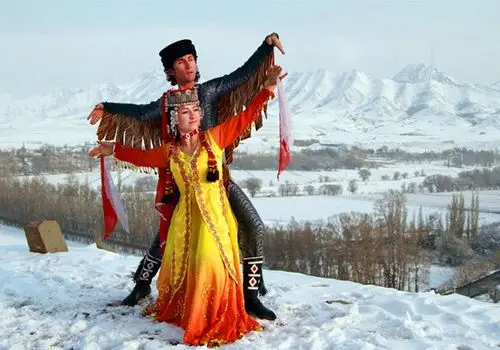
The Eagle Dance is a traditional dance of the Tajik ethnic group, primarily practiced in the southwestern part of the Xinjiang Uygur Autonomous Region of China. Embraced by towering mountains and snow-capped peaks, the Tajik people lead a semi-nomadic life. They regard the eagle as a symbol of strength and power in the high mountains, and have adopted it as their ethnic symbol.
The movements and rhythms of the Eagle Dance imitate the idealized gestures of eagles—twisting the waist, bending the body, and sweeping the arms backward, much like an eagle diving to seize its prey before soaring high into the sky. The performance often leaves spectators cheering in admiration.
A beautiful legend about the origin of the Eagle Dance has been passed down among the Tajik people.
On the Pamir Plateau, a pair of young Tajik lovers who lived as slaves were torn apart by a cruel master. The young man was sent to herd livestock in the distant mountains, while the young woman was kept at home.
One day, while tending his flock, the young man saw an eagle soaring freely in the sky and was deeply moved. He took the wing bone of a dead eagle, drilled three holes into it, and crafted a flute. Every evening, he played the eagle-bone flute in the direction of the girl's dwelling, sending his longing through the melody that drifted with the wind to her ears.
The young woman, equally consumed by longing, often stood at the foot of the mountains gazing into the distance. One day, she watched a mighty eagle soaring, diving, and circling gracefully through the sky. Inspired, she began to imitate its movements, pouring all her yearning for her beloved and her desire for freedom into her dance. Thus, the Tajik Eagle Dance was born.
The eagle-bone flute and the Eagle Dance, inseparable as devoted lovers, carry this ancient and beautiful legend, expressing the rich emotions of the Tajik people.